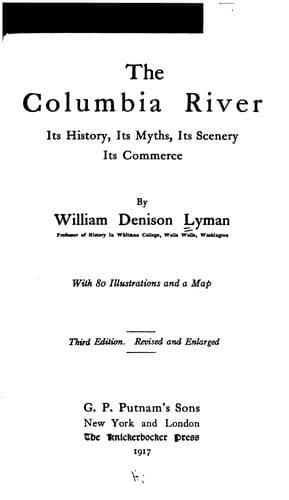
The Columbia River: Its History, Its Myths, Its Scenery, Its CommerceLyman, William Denison
History
The Columbia River: Its History, Its Myths, Its Scenery, Its Commerce
Lyman, William Denison
Columbia River; Columbia River -- Description and travel; Columbia River -- History
In 1863, the Oregon Steam Navigation Company was running boats from
Portland to Lewiston, over four hundred miles, having short railroad
portages at the Cascades and The Dalles. That was the most active era of
the mines in Idaho. Rates from Portland to up-river points were as
follows: freight from Portland to Wallula, $50.00 per ton; to Lewiston,
$90.00; fare from Portland to Wallula, $18.00; to Lewiston, $28.00. (The
rates had been much higher a year or two earlier.) From Wallula to Walla
Walla, freight was hauled by prairie-schooners at from $10.00 to $12.00 a
ton, thirty miles. Needless to say, the company piled up a fortune.
Dr. Baker saw the possibilities of the region and, almost unaided, with
every difficulty and discouragement, constructed a narrow gauge, with
wooden rails, on which strap-iron was fastened. An astonishing amount of
business was soon developed, steel rails were substituted, and the
business made a fortune for its builder. It was absorbed by the Oregon
Steam Navigation Company. But Dr. Baker's strap-iron road may be
considered the true progenitor of the railroads of the upper Columbia.
During these first years of the twentieth century, the shores of the River
have echoed with the sound of whistles on many a new road, but the
distinguishing mark has been the construction of electric roads. The lower
Willamette Valley, centring at Portland, has become fairly swarming with
electric roads. Spokane has become almost an equal centre of electric
lines, while Walla Walla is following close behind her larger sisters in
the procession. When lines already constructed from Spokane southward are
joined to a system projected from Walla Walla northward and westward,
there will be a complete system of independent electric lines from all
parts of Eastern Washington and North-eastern Oregon to steamboat
connections on the River, and thence to tide-water. The significance of
this as a commercial fact cannot be realised as yet.
[Illustration: A Logging Railroad, near Astoria. Photo. by Woodfield.]
CHAPTER XII
The Present Age of Expansion and World Commerce
Population and Productions of the Region on the River and its
Tributaries--Extent of its Navigability--Improvements Needed--Kinds of
Traffic--Local Traffic--Transcontinental Traffic--World
Traffic--Advantages of the River Route for these Kinds of Traffic--The
Bar--The Competition of Puget Sound--The Combination of River Route
and Sound Route.
We have traced the successive eras which have brought the land of the
Oregon from a wilderness to a group of powerful young American States,
abounding in resources and filled to the brim with hope and enthusiasm. We
have followed the River through its eras of canoe, bateau, flatboat,
sail-ship, and steamboat, and we have seen railroads built along its
banks. It remains only to cast a brief final glance at the River in its
present age, and to forecast something of what seems its sure future.
Public-domain text, read in full here on John Shaqi.
Reviews
Reviews
No reviews yet
Be the first to share your thoughts on this work.
Elsewhere in the archive
Join the Discussion
Join the discussion
Sign in to leave a comment or review.
Sign InorCreate an account