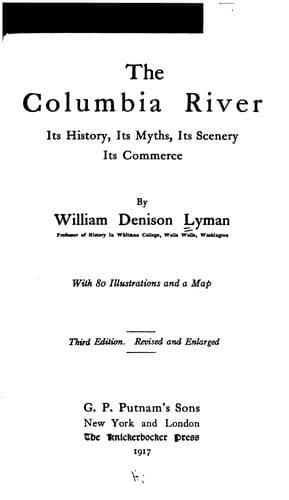
The Columbia River: Its History, Its Myths, Its Scenery, Its CommerceLyman, William Denison
History
The Columbia River: Its History, Its Myths, Its Scenery, Its Commerce
Lyman, William Denison
Columbia River; Columbia River -- Description and travel; Columbia River -- History
It is evident that there will be three kinds of traffic: local,
transcontinental, world-wide. Each is bound to be vast beyond the
calculations or even the imagination of the present. The local traffic is
sure to be immense, for it is estimated that there is a million acres of
land immediately contiguous to the River, irrigable and adapted to
intensive farming. Present experience shows that five or ten acres of such
land are sufficient to support a family. Many cities and towns are sure to
grow upon the banks of the River. Its banks will sometime become populated
like those of ancient Nile. Besides the immediate region of the River,
there are millions upon millions of acres of land more remote, the great
wheat fields and stock ranges and valley lands of tributary streams, and
these broad areas will seek the river route. Much of this immense local
traffic of the future will be conveyed by steamboats and barges.
The second class of traffic will be the transcontinental. All the
railroads across the continent, except those down the Columbia, are
obliged to climb the Cascade Mountains, four thousand feet or more in
height. With difficulty two powerful locomotives pull a freight train of
forty cars up the grades, and at some points even a third is needed. But a
single locomotive will pull eighty cars on the level grades of the River
roads. In the even keener competition bound to come, this advantage of
grades and curves will be a factor of immense importance.
The third class of future commerce is the world-wide. No western American
can contemplate the future of the world without being persuaded that the
Pacific Ocean and its shores will be the scene of the greatest problems of
the twentieth century. If this prove true, that world commerce of the
Pacific will seek that point of the American continent which most swiftly
and cheaply communicates with the eastern side of the continent and with
Europe. Granting that a large part of world commerce will pass through the
Panama Canal, there will still be, without question, an immense trade
between the Orient and such points in our own country as are so far from
the Atlantic seaboard that a transcontinental route is a necessity.
Moreover, even for our Atlantic seaboard and for Europe, there will be
large amounts of products, for the transit of which time will be a great
object. Hence we may be sure that there will be extensive world commerce
across the American continent. If so, where will it cross? Inspection of a
globe demonstrates that the Columbia River route is shortest, and, for
reasons already given, it is cheapest of all.
Public-domain text, read in full here on John Shaqi.
Reviews
Reviews
No reviews yet
Be the first to share your thoughts on this work.
Elsewhere in the archive
Join the Discussion
Join the discussion
Sign in to leave a comment or review.
Sign InorCreate an account