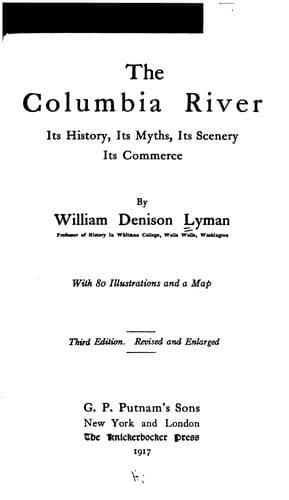
The Columbia River: Its History, Its Myths, Its Scenery, Its CommerceLyman, William Denison
History
The Columbia River: Its History, Its Myths, Its Scenery, Its Commerce
Lyman, William Denison
Columbia River; Columbia River -- Description and travel; Columbia River -- History
(on one occasion requiring a steamer three days to ascend the ten miles)
that it cannot be considered commercially navigable. It will doubtless
become necessary to construct a canal and locks at this point to render
the River continuously and profitably navigable.
Alexander Ross, in his _Adventures on the Columbia_, tells us how Priest
Rapids came to be named. The first expedition of the Pacific Fur Company,
of which Ross was a member, was making its way from Astoria up the River
in 1811, and had reached the lower end of this fall. While reconnoitring
and making preparations for proceeding, a large body of Indians gathered,
watching operations with great interest. Among them was a fantastically
dressed individual, with many feathers on his head, who was going
through some kind of a performance which the explorers conceived to have
a religious significance. Considering him a priest, they named the rapids
thus.
[Illustration: Starting the Ploughs in the Wheat Land, Walla Walla, Wash.
Photo. by W. D. Chapman, Walla Walla.]
The country around Priest Rapids is barren and unpromising in its natural
state, but just below the foot of the rapids is one of the most
interesting irrigation projects in the State. Along the west side of the
River for twenty-five miles extends a belt of the most fertile land. An
immense pumping plant run by electricity, which in turn is generated by
the current, has been put in at the foot of the rapids. By this the water
is conducted over the twenty thousand or more acres of land available, and
it is the expectation that within a few years a dense population will line
the river bank and repeat on a larger and finer scale the miracle of
redemption by water already performed at various points on the River and
its tributaries. Several town sites, of which the chief is Hanford, named
from the president of the company, have already been laid out, and
investments both in town property and orchard land are being rapidly made.
The same process of irrigating is becoming inaugurated at many points from
Hanford for a hundred and fifty miles down the River. It is plain to the
observer that it is but a question of time when the shores of the River in
this arid section will bloom and blossom like the rose, and repeat the
history of Old Nile in massing of population and creation of cities and
towns. It has been estimated that there are about a million acres of
irrigable land contiguous to the River between Chelan and The Dalles.
Since from five to twenty acres of irrigated land are ample to maintain a
family, and since cities and villages are bound to grow on such tracts
commensurate with their productive capacity, it seems probable that a
million people will sometime live on this long belt of fertile soil
redeemed by the River.
Public-domain text, read in full here on John Shaqi.
Reviews
Reviews
No reviews yet
Be the first to share your thoughts on this work.
Elsewhere in the archive
Join the Discussion
Join the discussion
Sign in to leave a comment or review.
Sign InorCreate an account