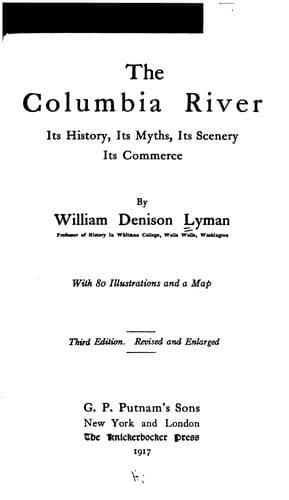
The Columbia River: Its History, Its Myths, Its Scenery, Its Commerce — John Shaqi
The Columbia River: Its History, Its Myths, Its Scenery, Its CommerceLyman, William Denison
History
The Columbia River: Its History, Its Myths, Its Scenery, Its Commerce
Lyman, William Denison
Columbia River; Columbia River -- Description and travel; Columbia River -- History
The struggle is short and Chinook's victory is sure.
Nearly all our native races had a more or less coherent idea of a future
state of rewards and punishments. "The happy hunting ground" of the
Indians is often referred to in connection with the Indians of the older
part of the United States. Our Indians have ideas in general quite
similar. Some believe that there is a hell and a heaven. The Siskiyou
Indians in Southern Oregon have a curious idea similar to that of the
ancient Egyptians as well as of the Mohammedans. This is to the effect
that the regions of the blessed are on the other side of an enormously
deep chasm. To pass over this, one must cross on a very narrow and
slippery pole. The good can pass, but the bad fall off into empty space,
whence they reappear again upon the earth as beasts or birds.
The Klickitat Indians, living along The Dalles of the Columbia have a fine
legend of the land of spirits. There lived a young chief and a girl who
were devoted to each other and seemed to be the happiest people in the
tribe, but suddenly he sickened and died. The girl mourned for him almost
to the point of death, and he, having reached the land of the spirits,
could find no happiness there for thinking of her. And so it came to pass
that a vision began to appear to the girl at night, telling her that she
must herself go into the land of the spirits in order to console her
lover. Now there is, near that place, one of the most weird and funereal
of all the various "memaloose" islands, or death islands, of the Columbia.
The writer himself has been upon this island and its spectral and volcanic
desolation makes it a fitting location for ghostly tales. It lies just
below the "great chute," and even yet has many skeletons upon it. In
accordance with the directions of the vision, the girl's father made ready
a canoe, placed her in it, and passed out into the Great River by night,
to the memaloose island. As the father and his child rowed across the dark
and forbidding waters, they began to hear the sounds of singing and
dancing and great joy. Upon the shore of the island they were met by four
spirit people, who took the girl, but bade the father return, as it was
not for him to see into the spirit country. Accordingly the girl was
conducted to the great dance-house of the spirits, and there she met her
lover, far stronger and more beautiful than when upon earth. That night
they spent in unspeakable bliss, but when the light began to break in the
east and the song of the robins was heard from the willows on the shore,
the singers and the dancers fell asleep.
Public-domain text, read in full here on John Shaqi.
Reviews
Reviews
No reviews yet
Be the first to share your thoughts on this work.
Join the Discussion
Join the discussion
Sign in to leave a comment or review.
Sign InorCreate an account