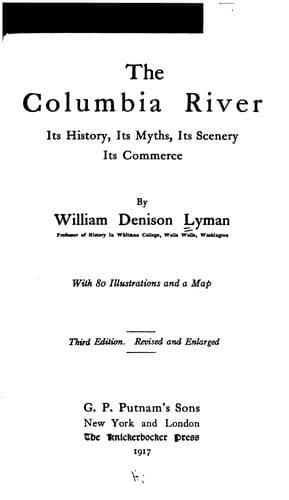
The Columbia River: Its History, Its Myths, Its Scenery, Its CommerceLyman, William Denison
History
The Columbia River: Its History, Its Myths, Its Scenery, Its Commerce
Lyman, William Denison
Columbia River; Columbia River -- Description and travel; Columbia River -- History
The girl, too, had gone to sleep, but not soundly like the spirits. When
the sun had reached the meridian, she woke, and now, to her horror, she
saw that instead of being in the midst of beautiful spirits, she was
surrounded by hideous skeletons and loathsome, decaying bodies. Around her
waist were the bony arms and skeleton fingers of her lover, and his
grinning teeth and gaping eye-sockets seemed to be turned in mockery upon
her. Screaming with horror, she leaped up and ran to the edge of the
island, where, after hunting a long time, she found a boat, in which she
paddled across to the Indian village. Having presented herself to her
astonished parents, they became fearful that some great calamity would
visit the tribe on account of her return, and accordingly her father took
her the next night back to the memaloose island as before. There she met
again the happy spirits of the blessed, and there again her lover and she
spent another night in ecstatic bliss. In the course of time a child was
born to the girl, beautiful beyond description, being half spirit and half
human. The spirit bridegroom, being anxious that his mother should see the
child, sent a spirit messenger to the village, desiring his mother to come
by night to the memaloose island to visit them. She was told, however,
that she must not look at the child until ten days had passed. But after
the old woman had reached the island, her desire to see the wonderful
child was so intense that she took advantage of a moment's inattention on
the part of the guard, and, lifting the cloth from the baby board, she
stole a look at the sleeping infant. And then, dreadful to relate, the
baby died in consequence of this premature human look. Grieved and
displeased by this foolish act, the spirit people decreed that the dead
should never again return nor hold any communication with the living.
In concluding this chapter we cannot forbear to call the attention of our
readers to the rare beauty of many of the native Indian names of
localities. These names always have some significance, and ordinarily
there is some such poetic or figurative conception involved in the name as
plainly reveals the fact that these rude and unfortunate natives have the
souls of poets beneath their savage exterior. It is truly lamentable that
some of the sonorous and poetic native names have been thrust aside for
the commonplace and oft-repeated names of Eastern or European localities
or the still less attractive names of discoverers or their unimportant
friends.
Public-domain text, read in full here on John Shaqi.
Reviews
Reviews
No reviews yet
Be the first to share your thoughts on this work.
Join the Discussion
Join the discussion
Sign in to leave a comment or review.
Sign InorCreate an account