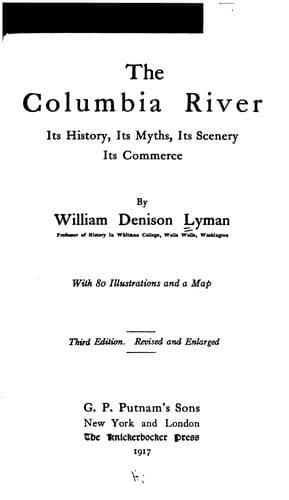
The Columbia River: Its History, Its Myths, Its Scenery, Its CommerceLyman, William Denison
History
The Columbia River: Its History, Its Myths, Its Scenery, Its Commerce
Lyman, William Denison
Columbia River; Columbia River -- Description and travel; Columbia River -- History
Portland is the centre of every species of transportation facility. It has
one of the most extensive and well-equipped electric railway systems in
the United States. In addition to the urban lines, there are interurban
lines in every direction, to Vancouver, Troutdale, Oregon City, Milwaukee,
Hillsboro, and Salem, the last named the capital of the State and fifty
miles distant. We find also that four transcontinental railroads have a
terminus in Portland, the Southern Pacific, the Northern Pacific, the
Union Pacific, and the Great Northern. Steamship lines run to Alaska,
Puget Sound, San Francisco and other California ports, to all the
coastwise ports of Oregon, to the Hawaiian Islands and the Orient, and to
Mexico and South America. Sailing ships convey the products of the
North-west to all the ports of the world.
As a result of these facilities for commerce we find such figures as the
following: During the year 1907 there entered and cleared at Portland
twelve hundred and twenty ocean-going vessels, registering more than
1,700,000 tons, net, and with a carrying capacity of 3,500,000 tons. In
the cargoes of this total, were 175,000,000 feet of lumber and 18,000,000
bushels of wheat, flour included. Portland has in fact reached the front
rank as a wheat and flour shipping port, being in the class with Galveston
and New York, some of the time having led both of them. In December, 1907,
Portland's record of wheat shipments, exclusive of flour, was 3,000,000
bushels. The Bureau of Statistics of the Department of Commerce and Labor
gave the value of all breadstuffs shipped from Portland for the eleven
months ending November 30, 1907, at $10,536,234. During the same period
the shipments of the same commodities from San Francisco totalled
$4,143,592, while from the three Puget Sound ports of Seattle, Tacoma, and
Everett, the aggregate was $13,989,178. During November, 1908, there were
shipped 903,000 bushels of wheat, 180,145 barrels of flour, 209,246
bushels of barley, and 9,752,552 feet of lumber. During the year 1908 the
value of wheat and flour reached a total of $18,340,405, while the lumber
exports aggregated 162,089,998 feet.
[Illustration: Among the Big Spruce Trees, near Astoria, Oregon. Photo. by
Woodfield, Astoria.]
Public-domain text, read in full here on John Shaqi.
Reviews
Reviews
No reviews yet
Be the first to share your thoughts on this work.
Elsewhere in the archive
Join the Discussion
Join the discussion
Sign in to leave a comment or review.
Sign InorCreate an account