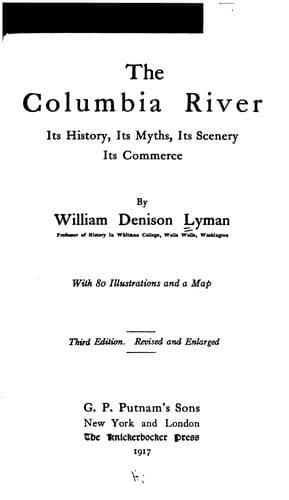
The Columbia River: Its History, Its Myths, Its Scenery, Its CommerceLyman, William Denison
History
The Columbia River: Its History, Its Myths, Its Scenery, Its Commerce
Lyman, William Denison
Columbia River; Columbia River -- Description and travel; Columbia River -- History
We have told something of the mountains, rivers, and lakes which make up
the framework of our Pacific North-west. We have also tried to see the
land through the eyes of the native red men, and have called back a few of
the grotesque, fantastic, sometimes heroic, sometimes pathetic legends
which they associated with every phase of their country.
Now the very centre of Indian lore, the Parnassus, the Delphi, the Dodona,
of the lower Columbia River Indians, is the stretch of mingled bluff,
plain, lake, sand-dune, and mountain, marvellously diversified, from the
south shore of the Columbia's mouth to the sacred Nekahni Mountain. It is
a wonderously picturesque region. From it came Tallapus, the Hermes
Trismegistus of the Oregon Indians. Its forests were haunted by the
Skookums and Cheatcos. From the volcanic pinnacles of Swallallochast, now
known as Saddle Mountain, the thunder bird went forth on its daily quest
of a whale, while at the mountain's foot Quootshoi and Toulux produced the
first men from the monstrous eggs of that same great bird. In short, that
region was rich in legend, as it was, and still is, in scenic beauty.
It is said by the Indians that a hundred years or more ago it was much
finer than now, for the entire breadth of Clatsop Plains was sodded with
deep green grass and bright with flowers almost the whole year through.
This bright-hued plain lay open to the sea, and across its southern end
flowed three tide streams, having the aboriginal names of Nekanikum,
Ohanna, and Neahcoxie.
It was a veritable paradise for the Indians. The forests were filled with
elk (moosmoos) and deer (mowitch), while fish of almost every variety
thronged the waters, from that king of all fish now known as the royal
chinook of the Columbia down to such smaller fry as the smelt and the
herring, which even now sometimes so throng the lesser streams that the
receding tide leaves them by the thousands on the muddy flats. On the
beach were infinite numbers of clams; and as an evidence of their
abundance we can now see shell mounds by the acre, in such quantity,
indeed, that some of the modern roads have been paved with shells.
Public-domain text, read in full here on John Shaqi.
Reviews
Reviews
No reviews yet
Be the first to share your thoughts on this work.
Join the Discussion
Join the discussion
Sign in to leave a comment or review.
Sign InorCreate an account