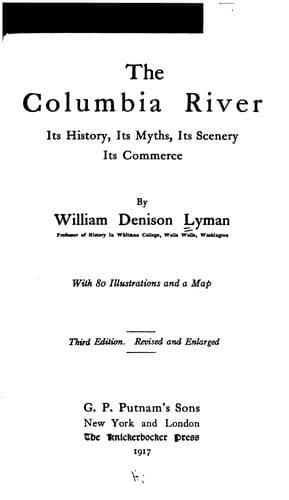
The Columbia River: Its History, Its Myths, Its Scenery, Its CommerceLyman, William Denison
History
The Columbia River: Its History, Its Myths, Its Scenery, Its Commerce
Lyman, William Denison
Columbia River; Columbia River -- Description and travel; Columbia River -- History
Think of using the names Salem and Portland for Chemeketa and Multnomah,
the native names. Chemeketa means "Here we Rest," or, some say, the "Place
of Peace," for it was the council ground of the Willamette Valley Indians.
But the Methodist missionaries thought that it would have a more Biblical
sound and conduce to the spiritual welfare of the natives to translate the
word into its equivalent, Salem. So they spoiled the wild native beauty of
the name for all time. Multnomah means "Down the Waters." But two Yankee
sea captains, with a sad deficiency of poetry in them, tossed up a coin to
decide whether to employ the name of Boston or Portland, the native town
of each, and the latter won the toss.
Oregon has been more fortunate than Washington in its State name, for it
has the unique name, stately and sonorous, which old Jonathan Carver first
used for the River and which is one of the most distinctive of all the
names of States. But whether Oregon is Indian, Spanish, French, or a
corruption of something else, or a pure invention of Carver's is one of
the mooted points in our history. Idaho, too, has one of the most
mellifluous of names, meaning the "Gem of the Mountains."
All three States have many beautiful and appropriate names of rivers,
lakes, mountains, and cities. Such are Chelan, "Beautiful Water";
Umatilla, "The Wind-blown Sand"; Walla Walla, "Where the Waters Meet";
Shuksan, "The Place of the Storm Winds"; Spokane, "The People of the Sun";
Kulshan, "The Great White Watcher"; Snoqualmie, "The Falls of the Moon
God." Seattle derives its name from the old chief Seattle, or Sealth.
The most bitterly disputed name of all is Tacoma _vs._ Rainier, as the
name of the greatest of our mountains. The name of Rainier was derived by
Vancouver from that of an officer of the British navy, a man who never
knew anything of Oregon and had no part or lot in its discovery or
development. Tacoma, or more accurately, _Takhoma_ (a peculiar guttural
which we cannot fully indicate), was the native Indian name, meaning,
according to some, "The Great White Mountain," and according to others
meaning "The Fountain-breast of Milk-white Waters."
With these glances at the character of the land, and its native
inhabitants, we are now ready to see how they became known to the world.
CHAPTER II
Tales of the First White Men along the Coast
Nekahni Mountain and Tallapus--Quootshoi and Toulux--Original Beauty
of Clatsop Plains--The Story Told by Celiast and Cultee--Casting of
the "Thing" upon the Beach--The Pop-corn--Burning of the
Ship--Konapee, the Iron-worker--Franchere's Account of Soto--The
Treasure Ship on the Beach at Nekahni Mountain--The Black Spook and
Mysterious Chest--The Inscription Still Found on the Rock--The Beeswax
Ship--Quiaculliby.
Public-domain text, read in full here on John Shaqi.
Reviews
Reviews
No reviews yet
Be the first to share your thoughts on this work.
Join the Discussion
Join the discussion
Sign in to leave a comment or review.
Sign InorCreate an account