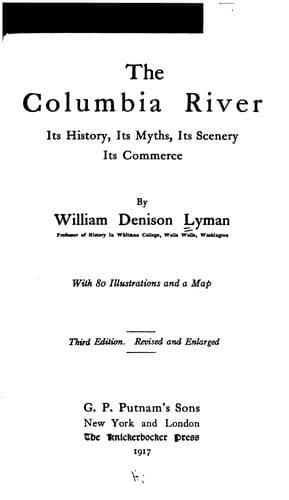
The Columbia River: Its History, Its Myths, Its Scenery, Its Commerce — John Shaqi
The Columbia River: Its History, Its Myths, Its Scenery, Its CommerceLyman, William Denison
History
The Columbia River: Its History, Its Myths, Its Scenery, Its Commerce
Lyman, William Denison
Columbia River; Columbia River -- Description and travel; Columbia River -- History
As a fit introduction to the picture of the land as it now appears, there
may be presented a brief record of the manner in which it was wrought into
its present form. Professor Thomas Condon of Oregon thought that the first
land to rise on the Pacific Coast was composed of two islands, one in the
region of the Siskiyou Mountains of Northern California and Southern
Oregon, and the other in the heart of what are now the Blue Mountains and
Saw-tooth Mountains of North-eastern Oregon, South-eastern Washington, and
Western Idaho. Other geologists have doubted the existence of the second
of these two islands.
Those islands, if both existed, were the nuclei of the Pacific Coast
region. The rock consisted of the earlier granite, sandstone, and
limestone crust of the earth. For long ages these two islands, washed by
the warm seas of that early age, and bearing a life now found in the
tropics, were slowly rising and widening their boundaries in all
directions.
Next, or perhaps as early, to respond to the pressure of the shrinking
crust of the earth and to appear above the sea, was the vast cordon of
pinnacled peaks which compose the present Okanogan and Chelan uplift,
granite and porphyry, broken by volcanic outflow. These peaks are veined
with gold, silver, and copper.
That first age of mountain uplift was ended by the coming on of the age of
fire. The granite upheaval of the Blue and the Cascade Mountains was blown
apart and cracked asunder by volcanic eruption and seismic force. A vast
outflow of basalt and andesite swept westward from the Blue Mountains to
meet a similar outflow moving eastward from the Cascades. Thus, throughout
the Columbia Basin, the surface is mainly of volcanic rock overlying the
shattered fragments of the original earth crust. At many points, however,
the primeval granite or sandstone surface was not covered, while at
frequent intervals the breaking forth of the fiery floods transformed
those original rocks into various forms of gneiss, porphyry, and marble.
But the greatest result of the age of volcanic outflow was the elevation
of the stupendous isolated snow peaks which now constitute so striking a
feature of Columbian landscapes.
Public-domain text, read in full here on John Shaqi.
Reviews
Reviews
No reviews yet
Be the first to share your thoughts on this work.
Join the Discussion
Join the discussion
Sign in to leave a comment or review.
Sign InorCreate an account