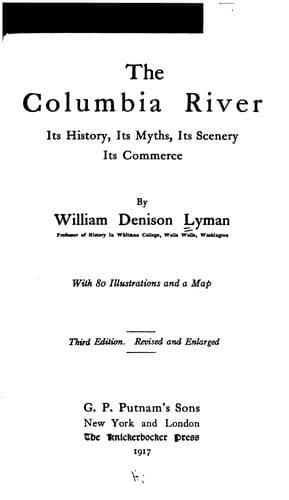
The Columbia River: Its History, Its Myths, Its Scenery, Its CommerceLyman, William Denison
History
The Columbia River: Its History, Its Myths, Its Scenery, Its Commerce
Lyman, William Denison
Columbia River; Columbia River -- Description and travel; Columbia River -- History
With the close of the age of fire, the mountain chains were in place, as
they now stand, but the plains and valleys were not yet fashioned. Another
series of forces must needs come to elaborate the rude outlines of the
land. And so came on the third great age, the age of flood. The upheaval
of the mingled granite and volcanic masses of the Cascade and Blue
Mountains, while at the same time the Rockies were undergoing the same
process, imprisoned a vast sea over the region now known by Westerners as
the Inland Empire. In the depths of this sea the sediment from a thousand
torrents was deposited to fashion the smooth and level valleys of the
Yakima, the Walla Walla, the Spokane, and lesser streams, while a similar
process fashioned the valleys of the Willamette and other streams between
the Cascades and the Coast Mountains westward.
But while the age of flood was shaping the great valley systems, a fourth
age--the age of ice--was working still other changes upon the plastic
land. The mountains had been reared by upheaval and volcanic outflow to a
stupendous height. Then they became glaciated. The whole Northern
Hemisphere, in fact, took on the character of the present Greenland.
Enormous glaciers descended the flanks of the mountains, gouging and
ploughing out the abysmal canyons which now awe the beholder, and scooping
out the deeps where Chelan, Coeur d'Alene, Pend Oreille, Kaniksu, and
other great lakes delight the vision of the present day.
Such were the forces that wrought the physical features of the land where
the River flows. We do not mean to convey the impression that there was a
single age of each, and that they followed each other in regular
chronological order. As a matter of fact there were several eras of each,
interlocked with each other: upheaval, fire, flood, and frost. But as the
resultant of all, the Columbia Basin assumed its present form. The great
forces which have thus fashioned this land manifested themselves on a
scale of vast energy. Evidences of upheaval, fire, flood, and glacier are
exhibited on every side, and these evidences constitute a testimony of
geological history of the most interesting nature. Long before this record
of the rocks had found a white reader, the native red man had read the
open pages, and interpreted them in the light of his ardent fancy.
The Indian conception of the flood, involving also that of the creation
of the native tribes, is one of the most fantastic native legends. This is
the story of the great beaver, Wishpoosh, of Lake Kichelos. According to
this myth the beaver Wishpoosh inhabited that lake on the summit of the
Cascade Mountains, the source of the Yakima River.
Public-domain text, read in full here on John Shaqi.
Reviews
Reviews
No reviews yet
Be the first to share your thoughts on this work.
Join the Discussion
Join the discussion
Sign in to leave a comment or review.
Sign InorCreate an account