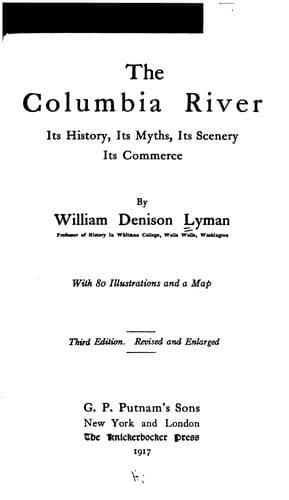
The Columbia River: Its History, Its Myths, Its Scenery, Its CommerceLyman, William Denison
History
The Columbia River: Its History, Its Myths, Its Scenery, Its Commerce
Lyman, William Denison
Columbia River; Columbia River -- Description and travel; Columbia River -- History
combatants he handed his own knife, a much more elegant one, to Yaktana,
saying in a friendly tone, "This is a chief's knife. Take it and give back
the other." There was an instant revulsion. Yaktana was so much flattered
that he turned at once into a stanch supporter of the shrewd trader. Food
was brought. The horses were restored. Equipment was provided. The three
women were regained, and the company made their way without further
trouble to Okanogan.
We have already mentioned the important fact that in 1821 the two great
Canadian Companies, the North-western and the Hudson's Bay, decided to
unite. With the union, the great era of fur-trade in the Columbia Basin
fairly began, to continue about twenty-five years, yielding then to the
American immigrant. That twenty-five years of the dominance of the great
Fur Company contained nearly all the poetry and romance as well as the
profit and statesmanship of the business. The entire region of the River,
as well as that of the Puget Sound country, was mapped out in a most
systematic manner with one chief central fort, Vancouver on the Columbia.
A more magnificent location for the purpose cannot be conceived. It is now
the site of a flourishing city and of the United States Fort Headquarters
for the North-west, generally conceded to be the finest fort location in
the United States. Fort Vancouver was established in 1825 upon a superb
bench of land gently sloping back from the River for two miles. Great
trees fringed the site, Mt. Hood lifted its pinnacled majesty sixty miles
to the eastward, the sinuous mazes of the Willamette Valley stretched out
far southward, while the lordly River was in full view a dozen miles up
and down. Every natural advantage and delight which wild nature could
offer was here in fullness. Ships could readily ascend the hundred miles
from the ocean to unload their merchandise and take on their cargoes of
precious furs, the furs collected at the outlay of so much toil and
suffering over the area of hundreds of miles. Every species of game and
fish abounded in the waters and along the banks of the River. Deer and elk
tossed their antlers between the stately firs of the upland, and pheasant
and grouse whirred among the branches. Geese, cranes, ducks, and swans, in
countless numbers, darkened the lagoons amid the many islands enclosed by
the mouths of the Willamette and the adjacent waters of the larger stream.
Fish of many varieties, the royal Chinook salmon, king of food fish, being
at the head in beauty and edibility, though surpassed in size by the
gigantic sturgeon, which sometimes weighed a thousand pounds, abounded in
the River. No epicure of the world's capitals could command such viands as
nature brought to the doors of the denizens of Fort Vancouver.
Public-domain text, read in full here on John Shaqi.
Reviews
Reviews
No reviews yet
Be the first to share your thoughts on this work.
Elsewhere in the archive
Join the Discussion
Join the discussion
Sign in to leave a comment or review.
Sign InorCreate an account