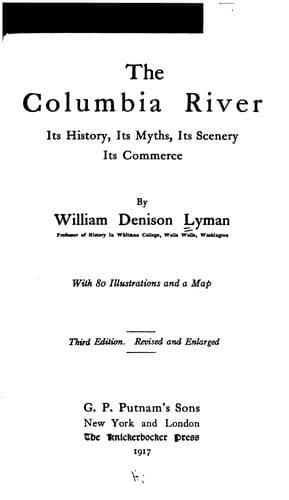
The Columbia River: Its History, Its Myths, Its Scenery, Its CommerceLyman, William Denison
History
The Columbia River: Its History, Its Myths, Its Scenery, Its Commerce
Lyman, William Denison
Columbia River; Columbia River -- Description and travel; Columbia River -- History
The fort itself was laid out on a scale of amplitude suitable to the
spaciousness of the site. It was enclosed with a picket wall twenty feet
high, with massive buttresses of timber inside. This enclosure was a
parallelogram seven hundred and fifty by five hundred feet. Inside were
about forty buildings, the governor's residence of generous dimensions
being in the centre. Two chapels provided for the spiritual needs of the
company, while schoolhouse, stores, "bachelors' halls," and shops of
various kinds attested the variety of the needs. Along the bank of the
River, outside the enclosure, lay quite a village of cottages for the
married employees, together with hospital, boathouses, granaries,
warehouses, threshing mills, and dairy buildings.
Taken altogether Fort Vancouver was the model fort of the western slope.
Moreover, the fertile soil and genial, humid climate soon encouraged the
factors of the Company to experiment with gardens and orchards, and,
within a few years after founding, fifteen hundred acres of land were in
the finest state of productivity, while three thousand head of cattle,
twenty-five hundred sheep, three hundred brood mares, and over a hundred
milch cows, added their bounteous contributions to the already plentiful
resources of the fort.
With this rich larder, with the spacious buildings, with the annual
arrivals and departures of ships by sea and fleets of bateaux by river,
with hunting trips and Indian policies, with the intercoast traffic with
the Russians on the north and the Spaniards on the south,--there was as
much to engage and delight the minds of these people as if they had lived
in the heart of civilisation.
Any account of Fort Vancouver would be incomplete without some reference
to Dr. John McLoughlin, chief factor of the Company in the Columbia
district from 1824 to the time of his retirement from the Company in 1846
and settlement at Oregon City, Oregon, as an American citizen. Rarely has
any one in the stormy history of the Columbia Basin received such
unvarying and unqualified praise as has this truly great man. Physically,
mentally, and morally, Dr. McLoughlin was altogether exceptional among the
mixed population that gathered about the emporium of the traders. Six feet
four inches in height, his noble and expressive face crowned with a great
cascade of snowy hair, firm yet kindly, prompt and businesslike yet
sympathetic and helpful, "Old Whitehead" or "White Eagle," as the Indians
called him, was a true-born king of men.
Public-domain text, read in full here on John Shaqi.
Reviews
Reviews
No reviews yet
Be the first to share your thoughts on this work.
Elsewhere in the archive
Join the Discussion
Join the discussion
Sign in to leave a comment or review.
Sign InorCreate an account