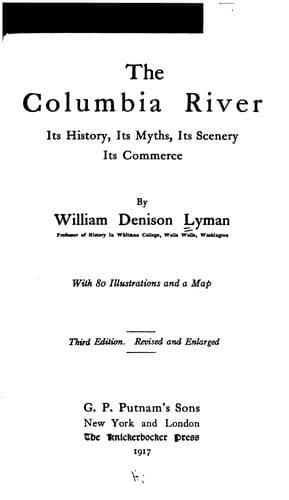
The Columbia River: Its History, Its Myths, Its Scenery, Its CommerceLyman, William Denison
History
The Columbia River: Its History, Its Myths, Its Scenery, Its Commerce
Lyman, William Denison
Columbia River; Columbia River -- Description and travel; Columbia River -- History
We have said that Fort Vancouver was the great central fort. The others
commanding the pivotal points upon the River and its tributaries were
Fort Hall and Fort Boise on the Snake, Spokane House on the Spokane near
the present metropolis of the Inland Empire, Fort Colville on the river of
the same name near its junction with the Columbia, Fort Okanogan at the
junction of the stream of that name with the great River, Fort Owen in the
Coeur d'Alene region, Fort Simcoe in the Yakima country, Fort Walla
Walla, first known as Fort Nez Perce, on the Columbia at the mouth of the
Walla Walla, and Fort George on the former site of Astoria. These forts
were all laid out in the same general fashion as Fort Vancouver, though no
one was so large, elaborate, or comfortable. Besides the forts there were
a number of small trading posts. The chief furs procured in the interior
were beaver, and those on the coast were sea-otter. Many others, as the
mink, sharp-toothed otter, fox, lynx, raccoon, were found in abundance.
The profits of the business were immense. Alexander Ross relates that he
secured one morning before breakfast one hundred and ten beaver skins for
a single yard of white cloth. Ross spent one hundred and eighty-eight days
alone in the Yakima country. During that time he collected one thousand
five hundred and fifty beavers, besides other peltries, worth in the
Canton market two thousand two hundred and fifty pounds, which cost him in
his objects of trade only thirty-five pounds. That was while Ross was
connected with the Astor Company.
In completing this necessarily hurried chapter on the fascinating era of
the fur-traders, we cannot omit a brief reference to the movements of the
regular brigades of boats up and down the River, for these comprised a
great part of both the business and the romance of the age. The course of
these brigades was from the southern shores of Hudson Bay, through
Manitoba, to the crest of the Rockies at the head of the Columbia. Water
was utilised to the greatest possible extent, while at the portages and
across the mountains horse-power and man-power were employed. Once afloat
upon the Columbia, the brigades braved most of the rapids, paying
occasional toll of men and goods to the envious deities of the waters, yet
with marvellous skill and general fortune making their way down the
thousand or more miles from Boat Encampment to Fort Vancouver. The descent
was easy compared with the ascent. The first journey of the east-bound
brigade of the North-westers from Astoria to Montreal was in 1814, and it
required the time from April 4th to May 11th to reach the mouth of Canoe
River, the point at which they entered upon the mountain climb to the head
of the Athabasca.
Public-domain text, read in full here on John Shaqi.
Reviews
Reviews
No reviews yet
Be the first to share your thoughts on this work.
Elsewhere in the archive
Join the Discussion
Join the discussion
Sign in to leave a comment or review.
Sign InorCreate an account