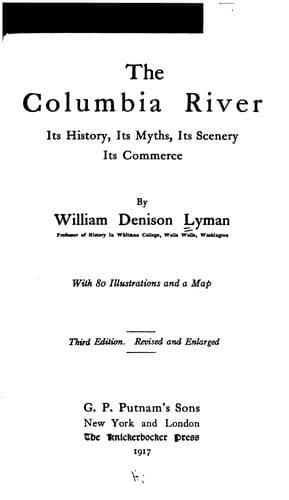
The Columbia River: Its History, Its Myths, Its Scenery, Its CommerceLyman, William Denison
History
The Columbia River: Its History, Its Myths, Its Scenery, Its Commerce
Lyman, William Denison
Columbia River; Columbia River -- Description and travel; Columbia River -- History
The boatmen were French-Canadians, a hardy, mercurial, light-hearted race,
half French, with the natural grace and politeness of their race, and
having the pleasant patois which has made them the theme of much popular
present-day literature. They were half Indian, either in tastes and
manners or in blood, with the atmosphere of forests and streams clinging
to every word and gesture. They were perhaps the best boatmen in the
world. Upon those matchless lakes into which the Columbia and its
tributaries expand at intervals the fur-laden boats would glide at ease,
while the wild songs of the _coureurs des bois_ would echo from shore to
shore in lazy sibilations, apparently betokening no thought of serious or
earnest business. But once the rapids were reached, the gay and
rollicking knight of the paddle became all attention. With keen eyes fixed
on every swirl or rock, he guided the light craft with a ready skill which
would be inconceivable to one less daring and experienced. The brigades
would run almost all the rapids from Death Rapids to the sea, making
portages at Kettle Falls, Tumwater or Celilo Falls, and the Cascades,
though at some stages of the water they could run down even them. They
always had to carry around those points in ascending the River. In spite
of all the skill of the _voyageurs_ the Columbia and the Snake, the Pend
Oreille and the Kootenai have exacted a heavy toll of life from those who
have laid their compelling hands upon the white manes of chute and
cataract. Many, even of the _voyageurs_, are the human skeletons that have
whitened the volcanic beds of the great streams.
The boats used by the fur brigades were either log canoes obtained of the
Indians or bateaux. The former were hollowed from the magnificent cedars
which grew on the banks of the River, sometimes fifty or sixty feet long,
with prow carved in fantastic, even beautiful fashion. They would hold
from six to twenty persons with from half a ton to two or three tons of
load, yet were so light that two men could carry one of the medium size
while four could handle one of any size around a portage. But the
_voyageurs_ never took quite so much to the canoes as did the Indians,
whose skill in handling them in high waves is described by Ross and
Franchere as something astonishing. And even the Indians of the present
show much the same ability, though the splendid cedar canoes are no
longer made, and only here and there can one of the picturesque survivors
be seen.
Public-domain text, read in full here on John Shaqi.
Reviews
Reviews
No reviews yet
Be the first to share your thoughts on this work.
Elsewhere in the archive
Join the Discussion
Join the discussion
Sign in to leave a comment or review.
Sign InorCreate an account