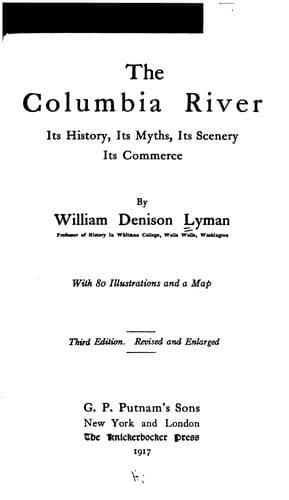
The Columbia River: Its History, Its Myths, Its Scenery, Its CommerceLyman, William Denison
History
The Columbia River: Its History, Its Myths, Its Scenery, Its Commerce
Lyman, William Denison
Columbia River; Columbia River -- Description and travel; Columbia River -- History
The bateaux were boats of peculiar shape, being built very high and broad
so that in an unloaded condition they seemed to rest on the water almost
like a paper shell. Both ends were high and pointed as prows. They were
propelled with oars and steered with paddles. One of the usual size was
about thirty feet long and five feet wide. Being of light-draft,
double-enders, capable of holding large loads and yet easily conveyed
around portages, more steady and roomy than canoes, these bateaux were the
typical Columbia River medium of commerce during the era of the
fur-traders. They, too, have mainly vanished from the scenes of their
former glory. Canoes, bateaux, cries and yells of Indians, songs of
_voyageurs_, have gone into the engulfing limbo of the bygone, along with
the keen-eyed Scotch factor and the sharp-featured Yankee skipper. Yet the
swans and geese and ducks still darken the more placid expanses of the
River and the salmon still start the widening circles in almost
undiminished numbers, while the glaciated heights of Hood and Adams and
St. Helens (we would rather say Wiyeast, Klickitat, and Loowit) still
stand guard over the unchanging waters.
This part of our topic has mainly centred upon the British possession of
the River. A full history of the fur era on the River would demand a
chapter on the later attempts of three remarkable men to reestablish
American interests in the disputed territory. These men were Jedediah
Smith, Capt. E. L. Bonneville, and Nathaniel J. Wyeth. But though these
men belong properly to this era, their efforts in the fur-trade were
relatively unimportant in comparison with the influence of their lives in
the direction of permanent American occupation. It seemed the appointment
of destiny that the American should play second fiddle to his British
rival in the fur-trade. But as tenfold, a thousandfold compensation, the
American farmers, home-builders, and tradesmen were to acquire final
possession of one of the goodliest lands on which the Stars and Stripes
has ever floated. The bateaux and canoes must needs give way to the
steamboat and the launch, the _coureur des bois_ to the lumberman and the
miner and farmer, and the picturesque emporium of the British fur-trader
on the River to the modern American city. We shall, therefore, more
fittingly chronicle the later American fur-traders as a part of the march
of their countrymen to permanent ownership of Oregon.
CHAPTER VI
The Coming of the Missionaries to the Tribes of the River
Public-domain text, read in full here on John Shaqi.
Reviews
Reviews
No reviews yet
Be the first to share your thoughts on this work.
Elsewhere in the archive
Join the Discussion
Join the discussion
Sign in to leave a comment or review.
Sign InorCreate an account