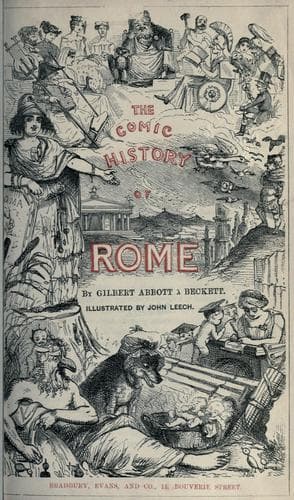
The Comic History of RomeÀ Beckett, Gilbert Abbott
History
The Comic History of Rome
À Beckett, Gilbert Abbott
Rome -- History -- Humor; Wit and humor, Pictorial
Those who would supply a higher motive to the ambition of C. Licinius,
have asserted that his wife must have been accustomed to the loud
knockings at the house of her father, who had once been consul; but
whether the young lady heard them, unless she remained at home to answer
the door, may be an open question. Whatever may have been the spur used
to stir up ambition in his breast, we, at all events, know the fact,
that C. Licinius was elected a tribune of the people, in conjunction
with his friend Lucius Sextius; so that even if the former were roused
by the knocker, it is not likely that ambition was hammered into the
latter by the same ignoble instrument.
Having obtained their places, they began to bid very high for
popularity; but, like many other bold bidders in the same market, it was
by no means at their own expense that they proposed to make their
purchases. They introduced three new laws: the first, touching other
people's money; the second, touching other people's land; and, in
reference to both these matters, touching and taking were nearly
synonymous.
The first of these laws related to the debts of the plebs, and
furnished an easy mode of payment, by providing that all the money paid
as interest should be considered as principal. By this arrangement, if
Spurius owed his tailor one hundred asses, and paid him five per cent.,
by way of interest, the tailor would, in thirty years, not only have had
his debt cancelled, without receiving his money, but he would have to
refund no less than fifty asses to Spurius.
This law was sure to obtain for its framers a certain kind of
popularity; for as those who do not meet their engagements are always a
numerous class, it is a safe clap-trap to legislate in favour of the
insolvent classes of the community. C. Licinius became at once the idol
of all those who were continually running into debt one day, and out of
the way the next, and whose valour far outstripped the discretion of
those who had trusted them.
The second law related to land, enacting that no one should occupy more
than five hundred jugera, or acres, and that if he had a surplus, he
should be deprived of it, for the benefit of those who wished to settle
their own liabilities with other people's property. From this
arrangement there was no appeal, for the land was taken away; and if the
owner wished to complain, he had no ground for it.
The third law provided for the restoration of the Consuls, and
stipulated that one should always be a plebeian; but the patricians, who
wanted everything their own way, just as the plebeians wanted everything
theirs, succeeded in putting a veto upon the propositions.
Public-domain text, read in full here on John Shaqi.
Reviews
Reviews
No reviews yet
Be the first to share your thoughts on this work.
Elsewhere in the archive
Join the Discussion
Join the discussion
Sign in to leave a comment or review.
Sign InorCreate an account