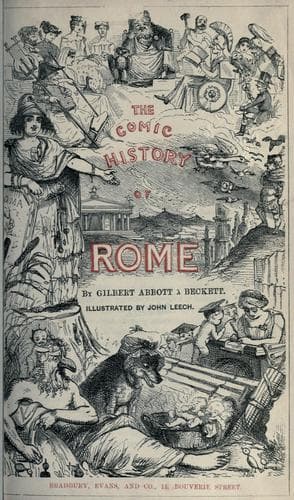
The Comic History of RomeÀ Beckett, Gilbert Abbott
History
The Comic History of Rome
À Beckett, Gilbert Abbott
Rome -- History -- Humor; Wit and humor, Pictorial
In the meantime, the people, placed between two parties--one of which
was seeking popularity at any price, while the other was endeavouring to
preserve its exclusive interests at any cost--were for eight years
deprived of all benefit from either side; and though the public would
have accepted a compromise, Licinius, who knew that when the point was
settled his popularity would be on the wane, declared that they should
either have all or nothing. This policy, which is the same as that of
prohibiting a starving man from accepting a moderate meal, unless he is
invited to a banquet, was well adapted to the purposes of those whose
happiness depends upon the dissatisfaction of all around, and to whom
the success of all their avowed designs is the consummation of failure.
As long as the bills continued to be thrown out year after year, C.
Licinius and Sextius were pretty sure of their annual election to the
tribuneship. At about the end of the fifth year, the opposition began to
wane, and it became exceedingly likely that the three bills would pass,
when Licinius kept the popularity market brisk, by proposing a fourth
measure, which was sure to be strenuously objected to. This was a
proposal to put on eight new hands to the keeping of the Sibylline
books, by increasing from two to ten the number of the librarians. As
the books were but three, there would, of course, be no less than three
book-keepers and a fraction to each volume,--an arrangement as
objectionable as pluralism, though in an opposite direction; for it is
scarcely worse to give ten offices to one man, than to put ten men into
one office. Excuses were, however, found for the suggestion, on the
ground that as five of the book-keepers were to be plebeians, the skill
they would acquire in the interpretation of auguries would qualify a
larger number for the consulship; the patricians having maintained that
at least a smattering of the fortune-telling art was required for the
due execution of the office.
Public-domain text, read in full here on John Shaqi.
Reviews
Reviews
No reviews yet
Be the first to share your thoughts on this work.
Elsewhere in the archive
Join the Discussion
Join the discussion
Sign in to leave a comment or review.
Sign InorCreate an account