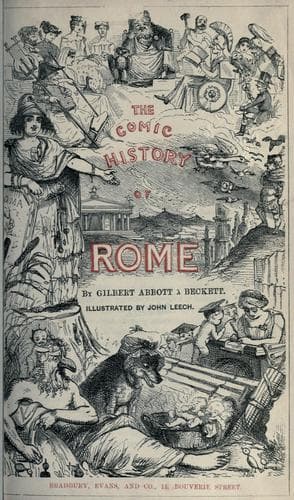
The Comic History of RomeÀ Beckett, Gilbert Abbott
History
The Comic History of Rome
À Beckett, Gilbert Abbott
Rome -- History -- Humor; Wit and humor, Pictorial
Rome was now suffering from domestic wounds, when, fortunately, a little
counter-irritation was got up, by an attack of the Veliternians on
Tusculum. There is no better cure for a family quarrel, than the sudden
incursion of a neighbour; and when relatives are breaking each other's
heads at Number One, a stone thrown from the garden of Number Two will
frequently, by the establishment of a single new wound, be the cause of
healing half a-dozen. The threatened aggression from without had caused
the ten Tribunes to agree to the measures of their colleagues, Licinius
and Sextius; but the patricians still held out, and appointed the
veteran Furius Camillus to the dictatorship. The tribes were in the act
of voting, when Furius ordered them away, with violent menaces; but the
fury of Furius was impotent from age, and the Tribunes coolly threatened
him with a fine of five hundred thousand asses. They had come to the
correct conclusion that he could not get together so many asses without
selling himself up; he thought it better to abdicate, and P. Manlius was
chosen to stop the fermentation that the sour old man had created.
The bills were now all passed; and L. Sextius had been appointed
plebeian consul, when the patricians, refusing to sanction what they
could not prevent, declined to ratify the election. As the avalanche
does not wait for the consent of the object it is about to sweep away,
so the will of the public overcame the feeble opposition of the
patricians. The latter, however, succeeded in taking a large portion of
power from the consuls, and giving it to a new magistrate, called a
Prætor, who was invested with authority that some historians have
described as almost preternatural. He was chosen from the patricians,
and was, in fact, a sort of third consul, whose duty it was _Jus in urbe
dicere_,[26] to lay down the law--a privilege that, if improperly
exercised, might include the prostration of justice--in the city. The
patricians thus kept to themselves the power of interpreting the law;
and as ambiguity seems inherent in the very nature of law, almost any
latitude was left to those who were at liberty to declare its meaning.
The power of the patricians was further augmented by the appointment of
two curule or aristocratic Ædiles, in addition to the two chosen from
the plebeians; and though their duties related chiefly to the mending of
the roads, they had opportunities of paving the way for many
encroachments on the part of their own order.
Public-domain text, read in full here on John Shaqi.
Reviews
Reviews
No reviews yet
Be the first to share your thoughts on this work.
Elsewhere in the archive
Join the Discussion
Join the discussion
Sign in to leave a comment or review.
Sign InorCreate an account