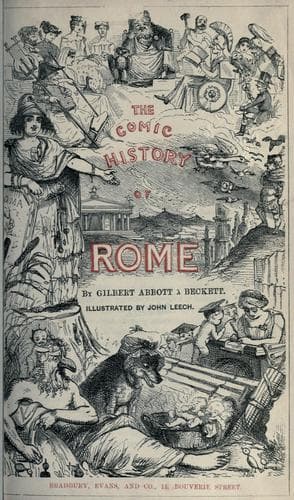
The Comic History of RomeÀ Beckett, Gilbert Abbott
History
The Comic History of Rome
À Beckett, Gilbert Abbott
Rome -- History -- Humor; Wit and humor, Pictorial
The struggle between the patrician and the plebeian parties was severe,
and each endeavoured to represent itself as the only real friend of the
people. Among other acts, in the interest of the masses, was a measure
introduced by C. Poetelius, consisting of a _lex de ambitû_, an election
law, relating to the getting round, or circumventing, of the electors by
the candidates. It will astonish those acquainted with election
practices to be told, that the word "candidate" is derived from
_candidus_, in allusion to the white robe usually worn as an emblem of
purity by the seeker of popular suffrages. The white robe, however, was
notoriously, in many cases, a white lie, and the law _de ambitû_ was
passed to prohibit canvassing on market-days, when many more things were
purchased than the articles ostensibly sold; and the butcher has been
known to include in the price of a calf's head, the value he placed upon
his own judgment.
The cause of reform made slow but inevitable progress, though it was
occasionally discredited by some of those incidents which still cause us
to look well to our pockets in the presence of the professional lover of
liberty. C. Licinius, the framer of the law against occupying more than
a certain quantity of the public land, was, it is said, the first to pay
the fine, for holding a double allowance, comprising five hundred jugera
in his own name, and five hundred in that of his son; a piece of
duplicity which was detected and duly punished. Other instances of
private peculation were discovered among those most clamorous for the
public good; and it became necessary in those days, as in our own, to
look among the loudest talkers for the smallest doers, and the greatest
doos of the community.
The law of debt had been rendered somewhat less severe; but the
impossibility of permanently helping those who could not help themselves
was strikingly exemplified. The rate of interest had been reduced; and
advances were to be made by the State to those who could give security;
but those who could give none were to have no assistance whatever. To
those who could pay no interest at all, it mattered little whether the
interest was moderate or high; and an extension of time for discharging
a debt, in the case of a man who could pay nothing, was only like
lengthening the rope with which he was to hang himself.
Public-domain text, read in full here on John Shaqi.
Reviews
Reviews
No reviews yet
Be the first to share your thoughts on this work.
Elsewhere in the archive
Join the Discussion
Join the discussion
Sign in to leave a comment or review.
Sign InorCreate an account