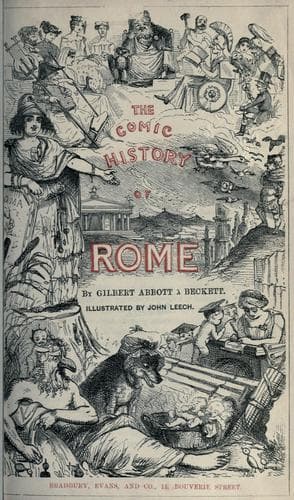
The Comic History of RomeÀ Beckett, Gilbert Abbott
History
The Comic History of Rome
À Beckett, Gilbert Abbott
Rome -- History -- Humor; Wit and humor, Pictorial
Rome continued at war with the Gauls, who made frequent inroads; and on
one occasion, during the dictatorship of T. Quinctius Pennus, came
within a short distance from the city. The two armies were divided by
the Anio, when the Gauls, who had a giant in their van, sent him on to
the bridge, with an offer to fight any one of the enemy. The Gaul being
at least twenty stone, was far above the ordinary pitch; but Titus
Manlius, a tight-built light-weight--the plebeian pet, who had already
proved himself too much for the Tribune, Pomponius--came forward to
accept the polite offer of the giant. The fight was one of extreme
interest, and both parties came up to the encounter with surly
confidence. The plebeian pet wore a suit of plain bronze; but the giant
was painted in various colours, presenting a formidable picture. The
giant aimed the first blow with his right, but the young one having got
away cleverly, commenced jobbing his opponent with such effect, that the
latter, finding it a bad job, fell heavily. The giant was unable to
continue the contest, and young Manlius, taking the collar, or torques,
from his victim's neck, got the title of Torquatus, which, from its
connection with his neckcloth, descended to his domestic ties, and
became a stock name in his family.
[Illustration: _The Gallant Curtius leaping into the gulf._]
[Illustration: Terrific Combat between Titus Manlius and a Gaul of
gigantic stature.]
The Gauls retreated for a while, but having subsequently joined the
Volscii, they got into the Pontine Marshes, and resolved to go through
thick and thin for the purpose of attacking the Romans. Again a giant
appeared in the Gallic ranks, where, it would seem, a giant was always
to be found,--an appendage indicating less of the brave than of the fair
in the composition of the Gallic army. Again a young Roman was ready to
meet an opponent twice his size; and Marcus Valerius declared that if
the giant meant fighting, he, Marcus Valerius, was to be heard of at a
place agreed upon. The terms were concluded, and the giant came up,
with the appearance of contemplating mischief, when a crow, settling on
the Gaul's helmet, by way of crest, soon enabled the Roman to crow over
his crest-fallen antagonist. The bird, flapping his wings whenever the
giant attempted to hit out, put so many feathers in his face as to
render his position ticklish; and as he could not see with a bundle of
crow-quills in his eye, his look-out became rather desperate. Valerius,
in the mean time, laid about him with such vigour and effect, that the
giant, who was doubly blinded with rage and feathers, knew not where to
have him. The contest soon terminated in favour of the Roman youth, who
took the name of Corvus, or the Crow, from the cause already mentioned.
The Gauls were vanquished, and Valerius was awarded no less than ten
prize oxen; so that he obtained in solid beef, rather than in empty
praise, an acknowledgment of his services. At his triumph, 4000
Public-domain text, read in full here on John Shaqi.
Reviews
Reviews
No reviews yet
Be the first to share your thoughts on this work.
Elsewhere in the archive
Join the Discussion
Join the discussion
Sign in to leave a comment or review.
Sign InorCreate an account