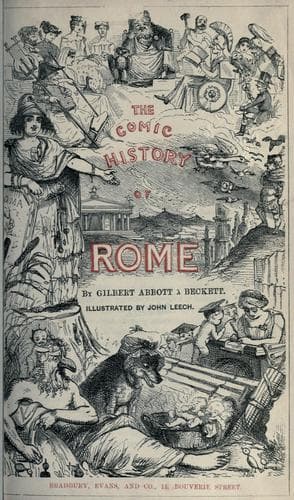
The Comic History of RomeÀ Beckett, Gilbert Abbott
History
The Comic History of Rome
À Beckett, Gilbert Abbott
Rome -- History -- Humor; Wit and humor, Pictorial
Volscians were drawn up on each side of him in chains; but there is
something in the idea of his passing through this Fetter Lane which is
repugnant to our more civilised notions of true glory.
FOOTNOTES:
[26] Livy, vi., 42.
[27] The word "Histriones" is said to be derived from the Etruscan
_hister_, a dancer. The earliest performers introduced into Rome were
dancers--in fact, a ballet company--from Etruria. Those sensitive
admirers of the purely classical in the entertainments of the stage, who
clamour against opera and ballet, will, perhaps, be surprised to learn
that the most truly classical performances are those which they most
energetically protest against.
CHAPTER THE ELEVENTH.
FROM THE FIRST WAR AGAINST THE SAMNITES TO THE PASSING OF THE LAWS OF
PUBLILIUS.
[Illustration]
The Romans were now about to encounter a truly formidable foe, in the
Samnites,--a warlike people, who had been extending their territory, by
going to great lengths, and allowing themselves extraordinary latitude.
Coming down upon Campania, they overlooked Capua, or rather they did not
overlook it; for, having an eye to its wealth, they resolved to do their
utmost to become possessed of it. Under these circumstances, the
Campanians, being unable to find the means of a successful campaign,
applied to Rome for assistance.
Two consular armies were equipped; one under M. Valerius Corvus, or the
Crow, who was really ravenous for glory, and the other under A.
Cornelius Cossus; this A. Cossus being in fact THE Cossus already spoken
of.[28]
Corvus was an enormous favourite with the soldiers; less, however, on
the strength of his moral qualities, than on the strength of his arms
and legs; for he was an athlete of remarkable power. He could leap so
high as to be able to jump over the heads of others of his own standing;
and the rapidity of his promotion is therefore not astonishing. He was
no less light with his tongue than with his legs; for he could run on
almost as pleasantly with the former as he could with the latter. He
was, in fact, an agreeable rattle, who could make and take a joke with
equal ease,--a quality common in more modern times; for those who
profess to make jokes of their own are very much in the habit of taking
those of other people. He loved a glass of wine, and could drink it
without professing his connoisseurship, after the manner of those
learned wine-bibbers of the present day who are addicted to talking so
much unmeaning buzz on the subject of bees-wing. His relish for the
grape allured him to Mount Gaurus, then clad with vines, where he could
take his observations among the raisins, and make in his mind's eye a
sort of _catalogue raisonnée_ of the enemy.
Public-domain text, read in full here on John Shaqi.
Reviews
Reviews
No reviews yet
Be the first to share your thoughts on this work.
Elsewhere in the archive
Join the Discussion
Join the discussion
Sign in to leave a comment or review.
Sign InorCreate an account