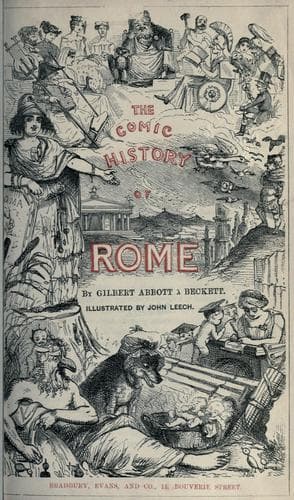
The Comic History of RomeÀ Beckett, Gilbert Abbott
History
The Comic History of Rome
À Beckett, Gilbert Abbott
Rome -- History -- Humor; Wit and humor, Pictorial
be marked out with a plough, to which were yoked a heifer and a bull, a
ceremony from which, perhaps, the English term bulwarks, and the French
word boulevards or bulvards, may or may not be derivable. The line thus
traced was called the Pomœrium, and where an entrance was to be made, it
was customary to carry the plough across the space--a little engineering
difficulty that gave the name of Porta to a gate, from the verb
_portare_, to carry. Remus looked on at the proceedings in a
half-quizzing, half-quarrelsome spirit, until the wall rose a little
above the ground, when he amused himself by leaping derisively over it.
"Thus," said he, "will the enemy leap over those barriers." "And thus,"
rejoined the superintendent or clerk of the works--one Celer, who acted
in this instance with thoughtless celerity--"thus shall die whoever may
leap over my barriers."[4] With these words he gave Remus a mortal
blow, and the legend goes on to state, that Romulus was immediately
seized with remorse, and subsequent visits from his brother's ghost
rendered Romulus himself little better than the ghost of what he used to
be. Remus showed as much spirit after his decease as during his
lifetime; and took the form of the deadly nightshade, springing up at
the bed-side, to poison the existence of his brother.
[Illustration: Awful appearance of the Shade of Remus to Romulus.]
Tradition tells us that Romulus came at length to terms with the ghost,
who agreed to discontinue his visits, in consideration of the
establishment of the festival of the Lemuria--called, originally,
Remuria--in honour of his memory. The rites were celebrated
bare-footed--an appropriate penalty for one who had stepped into a
brother's shoes; the hands were thrice washed--a process much needed, as
a sort of expiation for dirty work;--and black beans were thrown four
times behind the back, with the superstitious belief that the growing up
of the beans would prevent the stalking abroad of evil spirits. The
unfortunate twin was buried on Mount Aventine, and Romulus ordered a
double set of sceptres, crowns, and royal badges, in order that he might
set up one set by the side of his own, in honour of his late relative.
These duplicates of mere senseless symbols served only to commemorate
the double part which Romulus had acted; for a vacant throne and a
headless crown were but empty tributes to a murdered brother's memory.
Public-domain text, read in full here on John Shaqi.
Reviews
Reviews
No reviews yet
Be the first to share your thoughts on this work.
Join the Discussion
Join the discussion
Sign in to leave a comment or review.
Sign InorCreate an account