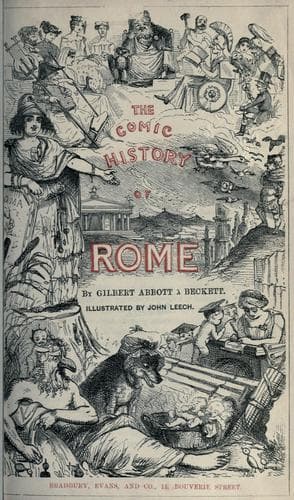
The Comic History of RomeÀ Beckett, Gilbert Abbott
History
The Comic History of Rome
À Beckett, Gilbert Abbott
Rome -- History -- Humor; Wit and humor, Pictorial
[Illustration: Remus jumping over the Walls.]
Romulus and Remus were the names of the two infants, who, as they grew
up, began to take after their foster-mother the wolf, turning out
exceedingly wild lads, with a lupine propensity for worrying the flocks,
and going on altogether in a very brutal manner. Remus was taken up on a
charge of sheep stealing, or something very like it, and brought before
Numitor, his own grandfather, when a recognition took place in a manner
not much in accordance with the ordinary rules of evidence. Romulus had
also been apprised of his relationship by Faustulus, who must have made
a pretty bold guess at a fact he could not have known; and the two lads,
being adopted by Numitor, were sent for their education to Gabii, where
everything was taught that men of rank in those days were expected to
learn, and whence the word Gaby is clearly derivable. Anxious to do
something for the old gentleman, their grandfather, Romulus and Remus
got up a demonstration in his favour, and they succeeded in restoring
him to the throne of Alba Longa, a long row of white houses, which was
less of a territory than a Terrace, and it is a strange coincidence that
Terracina, or little Terrace, formed one end of it. Amulius was killed,
and leaving Numitor sole master of White's Row, Romulus and Remus
resolved on a building speculation a great deal higher up--that is to
say on the spot where they had passed the days of their infancy. Before
the new city was commenced, a dispute arose, first, about what it
should be called, and secondly, as to who should govern it. Romulus and
Remus, being twins, could not bring the law of primogeniture to bear
upon their little differences, and it was therefore agreed to refer the
matter to augury, which should decide who was to be inaugurated as the
ruler of the new colony. Romulus mounted the Palatine Mount, and Remus
took his station on the Aventine, when both began to keep a very sharp
look out for something ominous. Remus was the first to remark something
odd in the shape of six vultures flying from north to south, but Romulus
no sooner heard the news than he declared he had seen twelve, and the
question arose whether, figuratively speaking, the one bird in hand seen
by Remus should outweigh the two in the bush that subsequently appeared
to Romulus. The augur, when appealed to, gave, as usual, a very
ambiguous answer. It amounted, in effect, to the observation that there
were six of one and a dozen of the other; so that the soothsayer,
instead of having said anything to soothe, was far more likely to
irritate. Both parties claimed the victory; Remus contending for the
precedence usually granted to the early bird, and Romulus maintaining
that he had been specially favoured, by having been permitted to see so
many birds of a feather flock together. Romulus accordingly commenced
drawing his plans in the Etruscan fashion, by causing a boundary line to
Public-domain text, read in full here on John Shaqi.
Reviews
Reviews
No reviews yet
Be the first to share your thoughts on this work.
Join the Discussion
Join the discussion
Sign in to leave a comment or review.
Sign InorCreate an account