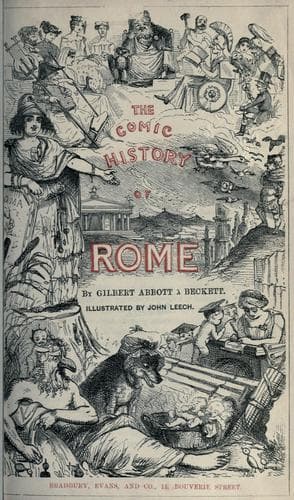
The Comic History of RomeÀ Beckett, Gilbert Abbott
History
The Comic History of Rome
À Beckett, Gilbert Abbott
Rome -- History -- Humor; Wit and humor, Pictorial
So inveterate was the hostility between Samnium and Rome, that any pause
in their actual conflict was filled up by preparations for a renewal,
the first opportunity for which they were eagerly expecting to take
advantage of. The third Samnite war was commenced by an attempt on the
part of the Samnites to recover Lucania, and for that purpose they
stupified the Lucanians by a series of severe beatings, which deadened
the sense of the inhabitants to their danger. The nobles, who seem to
have had the instinct of self-preservation in a higher degree than the
virtue of patriotism, were quite prepared to obey a master who would
purchase, rather than resist an enemy who would harass, them. They
accordingly offered their allegiance to Rome, on condition that Rome
would save them the trouble of defending themselves against Samnium.
Roman envoys were despatched, in compliance with this arrangement, to
call upon the Samnites to evacuate Lucania; but the envoys were
unceremoniously ordered off, and betook themselves to a very quick
return, unattended by the smallest profit. After a few minor encounters,
the two Consuls, Q. Fabius and P. Decius Mus, the son of old Mus,
already alluded to, led their combined forces into Samnium, and went
different ways, though they fully purposed pulling together. Q. Fabius
met the whole of the Samnite army, and a battle commenced, in which each
was rapidly destroying the other's soldiers in about equal numbers,
without any good to either, beyond the very melancholy satisfaction of
being even with each other in the losing game that both sides were
playing. This would probably have continued until the chances of war had
degenerated into a game of odd man, in which the sole survivor would
have been the victor, when a Samnite soldier, rather more far-seeing
than the rest, espied what he supposed to be the army of Decius. That
there are some things to which it is better to shut one's eyes, was
proved on this occasion; for the long-sighted Samnite had no sooner
espied a body of men in the back-ground, who were in reality the reserve
of Q. Fabius, than he frightened himself and his fellow soldiers, by
spreading a rumour that Mus was creeping slowly, but surely, up to them.
The Samnites were at once struck with a panic, the blow inflicted by
which is always more fatal than that of the sword, and the loss of
spirit led to the destruction of nearly the whole body. Decius having
joined his colleague, the two Consuls hunted the country of the
Samnites, making game of everything that came in the way, while Appius
Claudius carried on the war in Etruria. We should be curious to see the
population returns--if any such existed--in relation to the Samnites,
who were, according to tradition, being continually cut to pieces,
routed, ravaged, and otherwise destroyed; but who, nevertheless, were,
according to tradition, continually taking the field again in large
numbers, as if nothing had happened. L. Valerius had just returned from
Public-domain text, read in full here on John Shaqi.
Reviews
Reviews
No reviews yet
Be the first to share your thoughts on this work.
Elsewhere in the archive
Join the Discussion
Join the discussion
Sign in to leave a comment or review.
Sign InorCreate an account