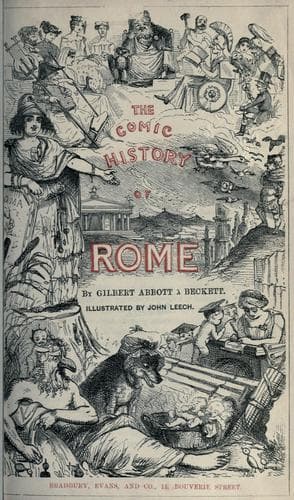
The Comic History of RomeÀ Beckett, Gilbert Abbott
History
The Comic History of Rome
À Beckett, Gilbert Abbott
Rome -- History -- Humor; Wit and humor, Pictorial
assisting his colleague, Appius Claudius, in Etruria, when the Samnites
turned up rather abundantly on the Vulturnus, and being at once
attacked, were again cut to pieces, for by no means the last or only
time on the great stage of history.
At about the same time, when the news of this victory reached Rome the
Gauls were expected, and though it was against the law that the same
Consul should be elected twice in ten years, the Romans, altering the
constitution, without the trouble of revision, suspended the law for the
purpose of securing the services of Q. Fabius.
He was re-elected with his colleague Decius Mus, and before setting out
for battle, they consulted the augurs, who evinced their usual readiness
to interpret the omens in the most favourable manner. On coming to the
fortified camp of Appius Claudius, Fabius found the soldiers collecting
wood, to form a stockade, which drew from him the remark, "It is not by
cutting sticks you can succeed, but by showing a bold front to the
enemy." The soldiers, animated by his words--which, to say the truth, do
not appear to have anything particularly invigorating about them--were
suddenly roused into lions, after having been in a lamb-like or sheepish
condition, and instead of cutting any more wood, or pulling up the
trunks of trees, began to pluck up a proper spirit. The Romans had now
about 90,000 troops in the field, if we adopt the round numbers handed
down to us, which do not always square with probability; but the
historians wisely provide, as far as possible, for any deficiency that
may arise in the course of the various cuttings to pieces,
annihilations, and other contingencies which are at one time or other
the alleged fate of nearly every army. The vast necessity for a surplus
that may be boldly dealt with, can perhaps be understood from a
circumstance recorded with reference to a legion led by L. Scipio. It
had been stationed near Camerinum, and had in an engagement with the foe
been cut to pieces without having been missed; nor was the loss
discovered until their own countrymen recognised their heads carried on
the lances of the advancing enemy. When the fact thus frightfully stared
them in the face, the countenances of the Romans fell with sympathy at
the fate of their comrades, which it must be confessed presented some
very horrid features.
Public-domain text, read in full here on John Shaqi.
Reviews
Reviews
No reviews yet
Be the first to share your thoughts on this work.
Elsewhere in the archive
Join the Discussion
Join the discussion
Sign in to leave a comment or review.
Sign InorCreate an account