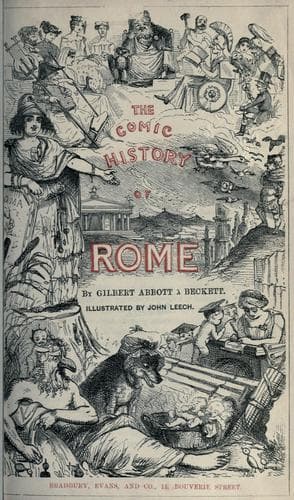
The Comic History of RomeÀ Beckett, Gilbert Abbott
History
The Comic History of Rome
À Beckett, Gilbert Abbott
Rome -- History -- Humor; Wit and humor, Pictorial
History, with a natural anxiety to keep a stock of Samnites on hand for
future use, suggests that 5000 ran away, though the Romans were too much
reduced to run after them, and as the fugitives lost a thousand of their
number by fighting, during their retreat, it must be presumed that, in
their extreme nervousness, they began attacking each other.
Q. Fabius led back his army into Etruria, which had recently been
thoroughly ravaged by Cn. Fulvius; and the Etruscans, who had already
been beaten once, were thoroughly beaten again, so that any residue of
strength might be effectually knocked out of them. The retreating
Samnites had by this time arrived at the valley of Vulturnus, where the
country was in such a state that they could find nothing to eat; but,
for a people who were accustomed to survive the constant infliction of
the sword, the absence of food was a very subordinate grievance.
Volumnius and Appius Claudius fell upon them with their united forces,
and the Samnites were once more cut to pieces; but, notwithstanding
their fragmentary condition, they were able to appear collected and
calm, before the end of the following year, in Etruria. They, at length,
mustered all their strength, and determined on making a desperate effort
against the Romans, who were in great force under Papirius Cursor, near
Aquilonia. Papirius sent for an augur, who kept a small brood of sacred
chickens, for the purpose of hatching up something to say to those who
consulted him. The augur declared that the omens were favourable, for
the chickens had eaten a hearty meal; but an officer, who had watched
the birds at breakfast, and had been struck by the extreme delicacy of
their appetites, came forward to impute foul play to the augur. Papirius
immediately ordered the soothsayer to be placed in the front of the line
of battle, where the poor old man, who was no chicken in age, whatever
he may have been at heart, was made to answer with his life for having
failed to answer with truth the questions proposed to him.
The Samnites paid no attention to omens, but bound each other by awful
oaths to undergo their usual fate of being cut to pieces rather than
surrender; and it must be admitted that they bore the penalty of defeat
with a coolness that can only be accounted for by their being thoroughly
used to it. No less than 16,000 took the oath, and kept it so well that
the whole 16,000 were found in bits precisely where they had taken their
places in battle. We might express our doubts upon this subject, were it
not that the sage critics, who are averse to any departure from the
gravity of history, would perhaps accuse us of levity in refusing
credence to Livy, on whose authority the tale is told, though dulness
itself will probably be roused to a stare, if incapable of a smile at
the remarkable dish of hash which the serious historians call upon him
to swallow.
[Illustration: Samnite Soldier.]
Public-domain text, read in full here on John Shaqi.
Reviews
Reviews
No reviews yet
Be the first to share your thoughts on this work.
Elsewhere in the archive
Join the Discussion
Join the discussion
Sign in to leave a comment or review.
Sign InorCreate an account