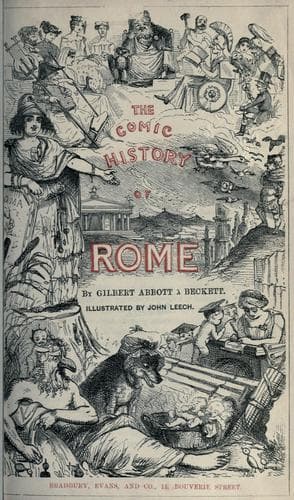
The Comic History of RomeÀ Beckett, Gilbert Abbott
History
The Comic History of Rome
À Beckett, Gilbert Abbott
Rome -- History -- Humor; Wit and humor, Pictorial
At about the same period other and more important measures were adopted
for infusing into the service of the State some of that intellectual
vigour which is to be found most abundantly in the main body of the
people. The pontiffs and the augurs had been hitherto chosen from the
patricians alone, when by the Ogulnian law, passed in the tribuneship of
Q. and Cn. Ogulnius, it was enacted that four pontiffs out of eight, and
five augurs out of nine--at which the numbers were then fixed--should be
plebeians. The science of augury certainly required no particular
talent; but, as its professors were held in very high repute, the
introduction of the plebeian element into the body, was a triumph for
popular principles. The divining rod in an age of superstition was also
a very powerful rod in the hands of those who held it; and the privilege
of reading or rather interpreting the signs of the times according to
the wish of the interpreter, was a source of so much influence among a
people guided by omens, that the admission of the plebeians to the
exercise of these functions was equivalent to allowing them an important
share in the government.
The science of augury is intimately connected with the history of the
Romans, for they never took a step of a private or a public nature
without consulting the soothsayers, who were, in fact, the
fortune-tellers of antiquity. That a nation should place its destinies
in such doubtful hands, seems in the present day as absurd as if the
Prime Minister, before arranging his measures for a session, were to
take counsel with Dr. Francis Moore, and the Opposition were to frame
their tactics on the advice of Zadkiel. A glimpse at the nature of the
art of augury will demonstrate to the student the ease with which the
seer could see exactly the thing he wanted. The subjects of his
observation were, first, the clouds, which afforded ample opportunity
for obscurity; secondly, the birds, which, when seen to the right, meant
exactly opposite to that which they indicated when seen on the
left--thus allowing for a good deal to be said on both sides; thirdly,
the chickens, who were supposed to give a favourable omen if they ate
abundantly--a theory which gave rise to many a tremendous cram;
fourthly, the quadrupeds, from which the augurs could easily draw a
deduction at all fours with their own wishes; and, fifthly, and last, a
miscellaneous class of signs, or incidents, comprising a sneeze, which
enabled the augur to lead the sneezer by the nose, or a casualty, such
as a tumble, which, in the absence of any other more important sign, the
soothsayer was always willing to fall back upon.
Public-domain text, read in full here on John Shaqi.
Reviews
Reviews
No reviews yet
Be the first to share your thoughts on this work.
Elsewhere in the archive
Join the Discussion
Join the discussion
Sign in to leave a comment or review.
Sign InorCreate an account