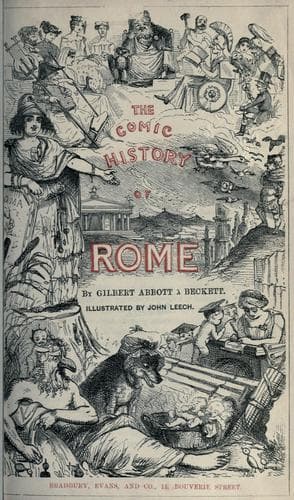
The Comic History of RomeÀ Beckett, Gilbert Abbott
History
The Comic History of Rome
À Beckett, Gilbert Abbott
Rome -- History -- Humor; Wit and humor, Pictorial
A remarkable instance of ignorance and superstition was afforded by the
conduct of the Romans, when the city, being in about its four hundred
and sixtieth year, was visited by a pestilence. Recourse was had to the
Sibylline books for a prescription to get rid of the plague, when the
augurs, like a doctor who, unable to cure his patient, orders him
abroad, declared that the only thing to be done was to go to Epidaurus,
a town in Greece, and bring to Rome the god Æsculapius. Ten ambassadors
were despatched on the mission; but after looking in all directions for
Æsculapius, they happened to stumble over a stone, in which they were
told he was resident. Having been induced to purchase the article at a
high price, they were taking it on board their ship, when they fell in
with the proprietor of a small menagerie, who, directing their attention
to a tame snake in the collection, offered it to them a bargain as the
identical Æsculapius they were looking for. The Roman envoys, thinking
there might, after all, be nothing in the stone, concluded there might
be something in the snake, which began to twine itself affectionately
about them; and having been bought and paid for, sagaciously glided
through the town, made for the Roman vessel, and coiled himself up like
a coil of rope in the cabin of the ambassadors.
On their way home, a storm caused them to put in at Antium, when the
snake, who might have been a very good snake, but was a very bad sailor,
went ashore, took a turn or two round a palm-tree, hung out there for
three days, and then went back to the vessel. On the arrival of the
ambassadors at Rome, they began describing at some length the result of
their journey, when the snake gave them the slip, and while their
tongues were running on, managed to run off to the island in the Tiber.
Having looked in vain for the snake in the grass, they built a temple on
the spot, in honour of Æsculapius, and the serpent glided on--no one
knows where--to the end of his existence.
Public-domain text, read in full here on John Shaqi.
Reviews
Reviews
No reviews yet
Be the first to share your thoughts on this work.
Elsewhere in the archive
Join the Discussion
Join the discussion
Sign in to leave a comment or review.
Sign InorCreate an account