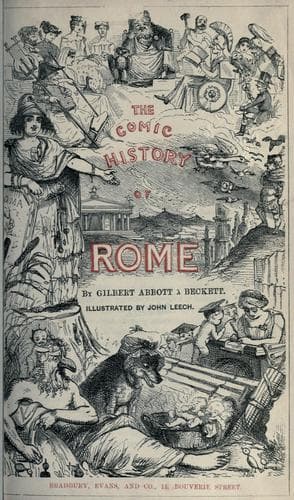
The Comic History of RomeÀ Beckett, Gilbert Abbott
History
The Comic History of Rome
À Beckett, Gilbert Abbott
Rome -- History -- Humor; Wit and humor, Pictorial
The wars which had been so exhausting to the almost inexhaustible
Sabines, had been scarcely less ruinous to the Romans, and indeed the
opening up of so many bones of contention had, to use the words of a
recent writer, consumed "the very marrow of the nation."[34] In spite of
all their conquests, the people were miserably poor; for destruction,
instead of production, had been their occupation during a series of
years; and though their wants had been supplied for a time by plunder,
scarcity was sure to ensue at last, from a stoppage of the very source
of all wealth, the peaceful exercise of industry. The tide of adversity
which, in the first instance, overwhelms only the lower ranks, rises,
with unerring certainty, until even the highest are absorbed, and few
are able, in the end, to keep their heads above water. When
circumstances appear hopeless, remedies become desperate, rash
legislation ensues, and thus, during the distresses of Rome, the plebs
having seceded, a proposal was adopted, in the shape of the Hortensian
Law, to allow them to do just as they liked, in order to tempt them back
again.
[Illustration: The Ambassadors purchasing Æsculapius.]
This was, happily, the last secession of the plebs, who, in their
dignified withdrawal, remained completely within the pale of the law,
while passing beyond the gates of the city. The intention of the
seceders was to get on as they could without the patrician class,
leaving the latter to do their best by themselves--a proceeding that had
speedily the effect of showing that there is a mutual dependence between
all ranks, and that one cannot exist in comfort without the association
and support of the other. In Rome, the patricians had played the
dangerous game of exercising the rights of their position without
fulfilling its duties; and the plebeians finding themselves deprived of
their share of the profits of the connection, were quite justified in
cutting it. After the passing of the Hortensian Law, the invidious
distinction between the patricians and the people was at an end, and the
word _populus_ was applied to the whole body of citizens; but with the
natural tendency of all classes to level only down to themselves, the
Romans who were well to do in the world continued to use the term
_plebs_, or _plebecula_, in a depreciatory sense, to denote the
multitude.
Public-domain text, read in full here on John Shaqi.
Reviews
Reviews
No reviews yet
Be the first to share your thoughts on this work.
Elsewhere in the archive
Join the Discussion
Join the discussion
Sign in to leave a comment or review.
Sign InorCreate an account