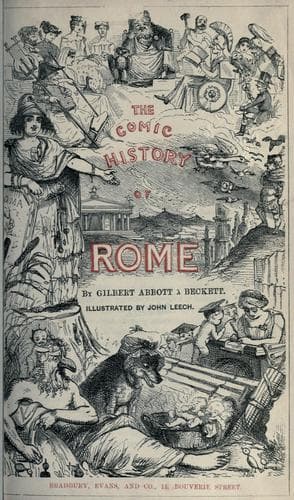
The Comic History of RomeÀ Beckett, Gilbert Abbott
History
The Comic History of Rome
À Beckett, Gilbert Abbott
Rome -- History -- Humor; Wit and humor, Pictorial
It is true, that some works of great utility were accomplished during
the unhappy period to which we have been alluding; and the aqueduct as
well as the Via Appia, to both of which we have already referred, were
executed at the time stated. Instead, however, of being the result of
the free industry of the nation, these undertakings were extorted
chiefly from the labour of the Samnite prisoners; so that the Romans may
be said to have watered their city with the tears, and paved their road
with the sighs,[35] of their miserable captives. The arts made
considerable progress, notwithstanding the general poverty, and perhaps
the fact, that necessity is the mother of invention, may account for the
stimulus given to the skill and ingenuity of the nation. The still
existing figure, in which two bronze babies are represented in an
attitude of playful satisfaction, deriving sustenance from a bronze
wolf, who looks as easy as the hardness of the material will allow, has
been assigned to the age alluded to, and the Sarcophagus of Scipio
Barbatus, complete even to the ancient funeral verse, which the
irreverent might estimate at the value of an old song, belongs,
probably, to the same period.
[Illustration]
FOOTNOTES:
[33] The Croton Aqueduct, commenced in 1837, and finished in 1842, for
conveying water from the river Croton to the City of New York.
[34] Dr. Schmidtz, p. 223
[35] The sigh of a pavier is really a very formidable matter. We always
fancy the heart of the poor fellow is in his mouth, whenever we hear him
at his labours.
CHAPTER THE FOURTEENTH.
FROM THE END OF THE THIRD SAMNITE WAR TO THE SUBJUGATION OF ALL ITALY BY
THE ROMANS.
[Illustration]
Rome was for a time at rest; but its repose was broken by the alarm-bell
of war still ringing in its ears, while dissension, hanging over it like
a nightmare, placed a weight upon its chest, and became a constant
burden on its resources. As if the Romans had not enough troubles of
their own, they became involved with the disputes of their foreign
relations, who were, most of them, very poor relations indeed--a sort of
connexion which nations, as well as individuals, are apt to find
extremely burdensome.
A number of petty states began urging each other to do something that
would embarrass Rome, and many who had not the courage to strike were
desirous of seeing others display their valour. The Tarentines and the
Volsinians being anxious to fight their own battles with other people's
arms, succeeded in making cats'-paws of the Gauls, who were induced to
pounce upon Arretium. The Romans were appealed to for assistance, and
they immediately sent an army just large enough to be too little. Defeat
ensued, as a matter of course; and L. Cæcilius, the leader, being slain,
M. Curius was despatched to head the troops; but on his arrival, he
found there was no body to which he could serve as a head, for the army
had been either killed or captured.
Public-domain text, read in full here on John Shaqi.
Reviews
Reviews
No reviews yet
Be the first to share your thoughts on this work.
Elsewhere in the archive
Join the Discussion
Join the discussion
Sign in to leave a comment or review.
Sign InorCreate an account