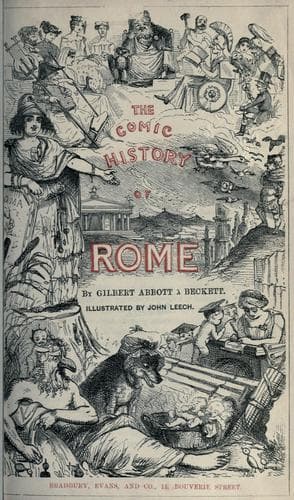
The Comic History of RomeÀ Beckett, Gilbert Abbott
History
The Comic History of Rome
À Beckett, Gilbert Abbott
Rome -- History -- Humor; Wit and humor, Pictorial
The weather being propitious, all the Sabine beauty and fashion were
attracted to the place, and the games, consisting of horse-racing, gave
to the scene all the animation of a cup day at Ascot. Suddenly, at a
preconcerted signal, there was a general elopement of the Roman youth
with the Sabine ladies, who were, in the most ungallant manner,
abandoned to their fate by the Sabine gentlemen. It is true that the
latter were taken by surprise, but they certainly made the very best of
their way home before they thought of avenging the wrong and insult that
had been committed. Had they been all married ladies who were carried
off, the cynic might have suggested that the Sabine husbands would not
have objected to a cheap mode of divorce, but--to make use of an
Irishism--there was only one single woman who happened to be a wife in
the whole of the "goodly company." The small Latin states, Antennæ,
Crustumerium, and Cœnina, were very angry at the supineness of the
Sabines, whose King--one Tatius--seemed disposed to take the thing
rather too tacitly. The three states above mentioned commenced an action
on their own account, and Acron, the King of Cœnina, fell in battle by
the hand of Romulus, who, stripping off the apparel of the foe, caused
it to be carried to Rome and hung upon an oak, where the arms and armour
of Acron, glittering among the acorns, were dedicated, as _Spolia
opima_, to Jupiter Feretrius.[5]
Though Tatius had been the last, he was not destined to be the least of
those taking part in the Sabine war; and he determined to rely less on
strategy than stratagem. The water in those days was not so well laid on
as in later times; when the lofty aqueducts, still running in ruins
about the neighbourhood of Rome, were carried to an elevation fitted for
the very highest service that could be desired. Rome, instead of being
well supplied, was supplied by wells; and ladies of rank were accustomed
to draw the water required for domestic purposes. It chanced, one
afternoon, that Tarpeia, the daughter of Tarpeius, the commander of the
Roman city, on the Capitoline Hill, was proceeding on an errand of the
sort, when she met with Tatius, who, addressing her in the language of a
friend, requested "a drink" of her pitcher. Tarpeia, dazzled by the
splendour of his gold bracelets and glittering armour, could not resist
the request of such a highly polished gentleman. Tatius had purposely
electrotyped himself for the interview, and, seeing the effect he had
produced, he intimated that he had several friends, who were covered
with metal quite as attractive as that he wore, and that, if Tarpeia
would only open the gate of the citadel to himself and party, she should
have more gold than she could carry. The bargain was faithfully kept on
both sides; for Tarpeia opened the gate to Tatius and the Sabines, who,
on their part performed their contract to the letter, for, as they
entered, they threw at her not only their bracelets but their
Public-domain text, read in full here on John Shaqi.
Reviews
Reviews
No reviews yet
Be the first to share your thoughts on this work.
Join the Discussion
Join the discussion
Sign in to leave a comment or review.
Sign InorCreate an account