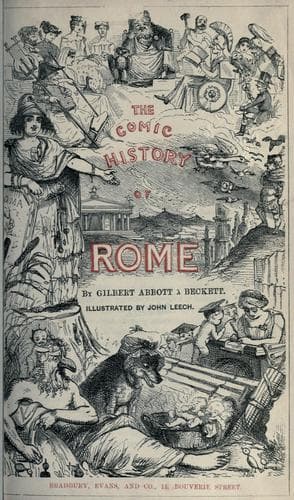
The Comic History of RomeÀ Beckett, Gilbert Abbott
History
The Comic History of Rome
À Beckett, Gilbert Abbott
Rome -- History -- Humor; Wit and humor, Pictorial
breast-plates, completely crushing her with the weight of the gold she
had coveted; and making her think, no doubt, that "never was poor woman
so unmercifully put upon." So thorough an illustration of an _embarras
des richesses_ is not often met with in history.
Being now possessed of the Capitoline, the Sabines were in an improved
position; and the Romans, having tried in vain to recover the citadel,
saw that they must either give in or give battle. Determining on the
latter course, Romulus selected the valley between the Palatine and the
Capitoline, where a general engagement began; but the Romans seemed to
have special engagements elsewhere, for they were all running away, when
their leader, with great tact, vowed a Temple to Jupiter Stator--the
flight-stayer. This gave to the action a decided re-action; for the
Romans, being rallied upon their cowardice, by their chief, began, in
their turn, to rally. The contest grew fierce on both sides, when
suddenly the Sabine ladies, who were the primary cause of the quarrel,
threw themselves into the midst; and, though female interference has
rarely the effect of making peace, the women were, on this occasion, the
cause of a cessation of hostility. It was agreed that the two nations
should be henceforth united under the name of Romans and Quirites, each
having a distinct king, a distinction which, had it continued, must in
time have led to a difference. In a few years, however, Tatius was slain
at a sacrifice which he had attended without the remotest idea of being
made a victim himself; and Romulus, finding nothing said about a
successor, thought it politic to hush the matter up without even
avenging his late colleague. Romulus is said to have reigned for
seven-and-thirty years; but when we enquire into the exact time and
manner of his death we learn nothing, beyond the fact that nobody knows
what became of him. According to the statement of one set of
authorities, he was attending a review in the Palus Capræ--a marsh near
the Tiber--when a total eclipse of the sun took place, and on the return
of light, Romulus was nowhere visible. If this was really the case, it
is probable that he got into a perilous swamp, where he felt a rapid
sinking; and all his attendants being in the dark as to his situation
were unable to extricate him from the marsh in which, according to some
authorities, he went down to posterity.
It must, however, be confessed, that when we look for the cause of
the death of Romulus in this fatal swamp, we have but very poor
ground to go upon. It is, nevertheless, some consolation to us for the
mystery that overhangs the place and manner of his decease, that his
existence is, after all, quite apocryphal; and we are not expected to go
into an elaborate inquiry when, where, and how he died, until the fact
of his having ever lived at all has been satisfactorily settled.
Public-domain text, read in full here on John Shaqi.
Reviews
Reviews
No reviews yet
Be the first to share your thoughts on this work.
Join the Discussion
Join the discussion
Sign in to leave a comment or review.
Sign InorCreate an account