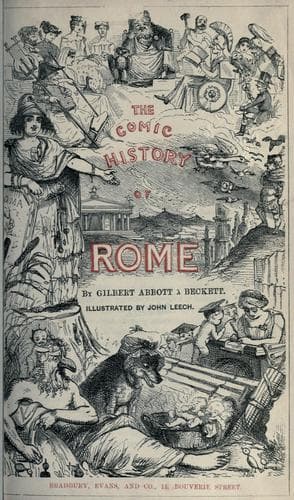
The Comic History of RomeÀ Beckett, Gilbert Abbott
History
The Comic History of Rome
À Beckett, Gilbert Abbott
Rome -- History -- Humor; Wit and humor, Pictorial
In this disagreeable dilemma, he sent ambassadors to know the terms on
which the prisoners would be given up; but the ambassadors--like good
money sent after bad--never came back again. The Romans perceiving at
last that they were only cutting their army into convenient pieces for
the enemy to swallow up, despatched, at length, a force large enough to
put a stop to any further consumption of such valuable material. The
Romans were now decidedly successful, and the Senones were, according to
certain authorities, "just annihilated;"[36] but as the Senones are
frequently met with again, it must be presumed that the assertion, _ex
nihilo nihil fit_--"nothing can come of nothing"--is unacknowledged by
the writers of classical history.
Foreign intervention seems to have been quite the order of the day; for
the Boians rushed forward to show their sympathy at the fate of the
Senones, which, if it consisted of annihilation, must have been nothing
to the parties themselves, and should have been, _à fortiori_, nothing
to others. Touched with a similar infection, the Etrurians began to
sympathise with the Boians, and having met the Romans near Lake Vadimo,
the sympathisers were "cut to pieces," if we are to believe report; but
we know not whether to the scissors of the reporters or the shears of
fate, the cutting to pieces in question may be attributed. The
Etruscans, at all events, were able to return to Etruria[37] in
sufficient force to render them a still formidable foe to the Romans,
who were eventually glad to grant a peace on very favourable terms; and,
putting all things together, we are inclined to believe that the
Etruscans were not in that very piecemeal state to which tradition is
fond of reducing them.
A quarrel between the Lucanians and the Thurii caused another call on
the intervention of Rome, who was a thorough polygamist in espousing the
quarrels of others. C. Fabricius was sent to the relief of Thurii with
an army so small, that it began to shrink from the encounter, and thus
increase, as it were, its own littleness. The spirit of the Romans had
something, however, of the caoutchouc in its composition; for it could
be drawn out as easily as it gave in, and a trifling circumstance showed
its elasticity on the occasion of the attack on Thurii. A gigantic lad,
with a ladder in his hand, was seen approaching the ramparts, which he
proceeded to mount, and by this simple act of scaling the wall, he
turned the scale of victory.
Public-domain text, read in full here on John Shaqi.
Reviews
Reviews
No reviews yet
Be the first to share your thoughts on this work.
Elsewhere in the archive
Join the Discussion
Join the discussion
Sign in to leave a comment or review.
Sign InorCreate an account