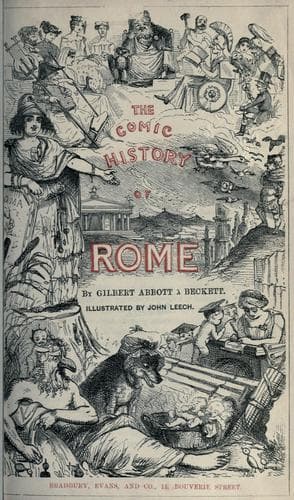
The Comic History of RomeÀ Beckett, Gilbert Abbott
History
The Comic History of Rome
À Beckett, Gilbert Abbott
Rome -- History -- Humor; Wit and humor, Pictorial
The battle was fought with determined bravery on both sides, but brute
force decided it at last, for the elephants of Pyrrhus weighed immensely
in the scale of victory. The creatures coming down _en masse_, were more
effective than the heaviest of ordinary heavies, and advancing with all
their might upon the horses, the latter, though resisting with all their
mane, felt their animal spirits rapidly oozing out of them. The carnage
committed upon the Romans would have been merciless and complete, had it
not been for the humanity of one of the elephants, who, taking a
benevolent turn, pulled himself short round, and prevented his own side
from continuing the pursuit of the fugitives. Pyrrhus, having laid his
hands on everything he could take, proceeded to take everything he could
lay his hands upon. A rich harvest having been collected, he, on the day
following, went to glean what he could on the field of battle.
Perceiving that the Romans had all fallen with their eyes towards the
foe, he could not but acknowledge, with so much bravery staring him in
the face, the courage of his antagonists. "With such soldiers as these,"
he exclaimed, "the world would be mine, or, at all events, it would be
theirs if I were their general." He had, however, lost half his own men;
and as they lay prostrate before him, they seemed to offer a flat
contradiction to the congratulations offered to him on his victory.
"Another such a triumph," he replied, "and I should return to Epirus
thoroughly unmanned, for there would not remain to me a single soldier."
He offered to the prisoners employment in his own army, but they,
without exception, refused; and, considering their conduct
unexceptionable, he had their chains taken off, that they might feel
themselves quite unfettered in their future movements. He burned the
bodies of the dead, out of compliment to their remains, whose
combustion, could they have acted for themselves, would no doubt have
been spontaneous. He made a tolerably fair division of the spoil, giving
some to his allies, and devoted a considerable slice to Zeus--a piece of
devotion of which the priests of the temple got the chief benefit.
Public-domain text, read in full here on John Shaqi.
Reviews
Reviews
No reviews yet
Be the first to share your thoughts on this work.
Elsewhere in the archive
Join the Discussion
Join the discussion
Sign in to leave a comment or review.
Sign InorCreate an account