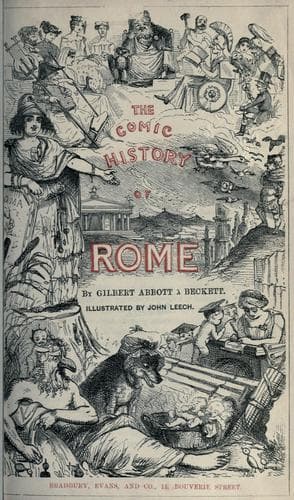
The Comic History of RomeÀ Beckett, Gilbert Abbott
History
The Comic History of Rome
À Beckett, Gilbert Abbott
Rome -- History -- Humor; Wit and humor, Pictorial
transaction, which, however, was characteristic of the future city, for
it became famous for its business and its bargains, as well as infamous
for its bad faith; the term _Punica fides_ having become a by-word to
express the grossest dishonesty. Her devotion to commerce led to the
establishment of a powerful navy, and her citizens having something more
profitable to do than to fight, her army was always hired from abroad
when occasion required. Rome, on the other hand, had made war her chief
pursuit, and the consequence was, that she had plenty of soldiers, but
no ships, except a few she had taken from her foes; and her occupations
being mostly of a military or destructive kind, she had no resources but
her valour to rely upon.
The Romans remained in Sicily, where several powers claimed their
protection; but Hannibal Gisco, anxious to preserve Agrigentum, threw
himself and sixty elephants into it. Here he was besieged for seven
months with an army of 50,000 men, who, of course, consumed daily a
large quantity of food; but there was something utterly irrational in
providing daily rations for sixty elephants. It was arranged, therefore,
that Hanno should proceed to the relief of Agrigentum, but he was
defeated with the loss of thirty elephants, left dead on the field--a
field which must have been necessarily a very wide one for conjecture.
Hannibal Gisco's army consisted of a medley of mercenaries, including
some Gauls, who, having much money owing to them, refused to strike,
except for their pay, and who intimated that they would not draw their
swords until they had drawn their salaries. Their general, unable to
settle with them in cash, chose a more treacherous way of paying them
off; for, getting them into an ambush, he caused a volley of missiles to
be aimed at them, and the discharge was in full of all demands, for it
effectually stopped all further clamour.
Agrigentum was plundered by the Romans, who sold 25,000 of the
inhabitants for slaves--at least, according to tradition, who usually
deals in round numbers, amounting often in value to the sum which a
perfectly round number or figure indicates.
Public-domain text, read in full here on John Shaqi.
Reviews
Reviews
No reviews yet
Be the first to share your thoughts on this work.
Elsewhere in the archive
Join the Discussion
Join the discussion
Sign in to leave a comment or review.
Sign InorCreate an account