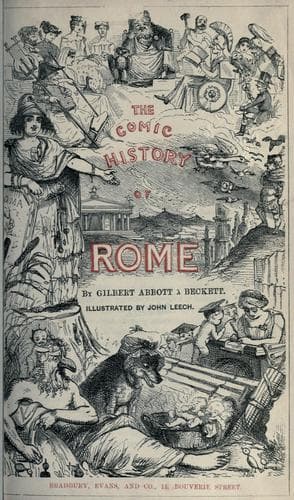
The Comic History of RomeÀ Beckett, Gilbert Abbott
History
The Comic History of Rome
À Beckett, Gilbert Abbott
Rome -- History -- Humor; Wit and humor, Pictorial
Having been invited to take his seat in the Senate, he at first refused,
but he yielded after a considerable amount of pressing; a proof that his
refusal was founded on no fixed principle. When asked for his opinion on
the Carthaginian question, he spoke against the arrangement he had been
sent home to further, and the noble Romans strongly urged him to stay
behind, though he had pledged his honour to return, and the Pontifex
Maximus, the head of the religion of the nation, devised a dodge by
which Regulus might have evaded his promise. It must, however, be
stated, to his credit, that he kept his word to the Carthaginians, and
returned among them; but instead of being hailed as a hero, he was
denounced as an impostor, and put to death in the most cruel manner. The
stories told of his being corked up in a cask filled with nails and
serpents, are altogether false; for, after carefully looking into the
matter, we are glad to be enabled to knock the cask to pieces by the
gentlest tap possible.
Rome, having refused to make peace, was compelled, in self-defence, to
go to war, and ordered 200 new ships with the recklessness of the
spend-thrift who, calling on his coachmaker, desired that "some more
gigs" should be immediately sent home to him. The Carthaginian fleet was
in the harbour of Drepana, when P. Claudius Pulcher--son of Appius the
blind, and who seems to have wilfully shut his eyes to the danger he
ought to have seen--determined to surprise the enemy. Every attempt to
dissuade him from his rash purpose was vain, and he persevered in spite
of the auspices, which were declared to be unfavourable; for the sacred
chickens were completely off their feed--a fact he set at defiance, by
observing that, if the birds would not eat, he would at least make them
drink; and he threw them all neck and crop into the water. The fate of
the chickens went to the hearts of the Roman soldiers, who became
thoroughly chicken-hearted, and fought so languidly, that they allowed
themselves to fall by hundreds into the hands of the enemy. The Senate
recalled Claudius to Rome, where a charge of high treason was preferred
against him; but a thunder-storm interrupted the proceedings, which were
never resumed, for the thunder seems to have cleared the air of all the
clouds impending over him. As he must have ultimately died in some way
or other, and as there are no records of his having been put to death,
history has returned an open verdict, which is equally adapted to the
suspicion that he came to his death by his own hands, or that it was
brought to him by the hands of his fellow countrymen.
Public-domain text, read in full here on John Shaqi.
Reviews
Reviews
No reviews yet
Be the first to share your thoughts on this work.
Elsewhere in the archive
Join the Discussion
Join the discussion
Sign in to leave a comment or review.
Sign InorCreate an account