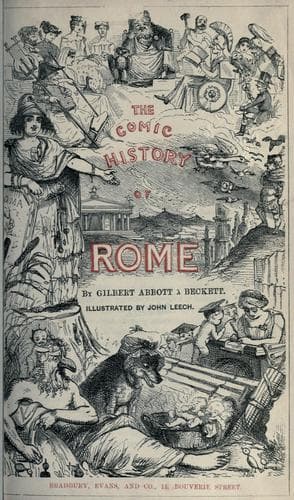
The Comic History of RomeÀ Beckett, Gilbert Abbott
History
The Comic History of Rome
À Beckett, Gilbert Abbott
Rome -- History -- Humor; Wit and humor, Pictorial
The reverses of Rome by sea were a second time the cause of her giving
up her naval establishments, and she sold her marine equipments to the
dealers in marine stores, at a ruinous sacrifice. Carthage, therefore,
became mistress of the seas; but the mistress being unable to pay the
wages she owed, began borrowing money of her neighbours. Ptolemy of
Egypt was applied to, but he civilly laid his hand on his heart,
declaring he had nothing to lend, and kept his money--if he had any--in
his pocket. In this dilemma, the command of the Carthaginians fell upon
Hamilcar, surnamed Barca, or the lightning, from his being one of the
fastest men of the day; and though any general, equal to the general
run, might head a force with plenty of money to pay the troops, a genius
was required to keep an army going, or rather to keep up a standing
army, with empty pockets. He found the mercenaries in a state of
insubordination for want of their customary emolument; but, having no
money of his own, he made Bruttium and Locri his bankers, and gave his
soldiers a general authority to draw, with their swords, for whatever
they required. Taking his position on Mount Hercte, now the Monte
Pelegrino, he maintained himself and his army for three years, enabling
his troops to carry out the principle of spending half-a-crown out of
sixpence a day--the sixpence being their own, and the half-crown being
anybody else's, from whom it could be most conveniently taken. After
remaining three years at Hercte, he removed to the town of Eryx,
intending to tire the Romans out; but like many others who attempt to
exhaust the patience of others, he found his own stock rapidly
diminishing. He was drawn into an engagement, in which he lost so many
of his soldiers, that he was obliged to ask for a truce to bury the
dead; but the Roman general would give him no undertaking not to proceed
during the funerals. A short time afterwards, when the fortune of war
had changed, Hamilcar was asked to give a similar permission, and, by
allowing the burials to proceed, he has raised a monument to his own
magnanimity.
Public-domain text, read in full here on John Shaqi.
Reviews
Reviews
No reviews yet
Be the first to share your thoughts on this work.
Elsewhere in the archive
Join the Discussion
Join the discussion
Sign in to leave a comment or review.
Sign InorCreate an account