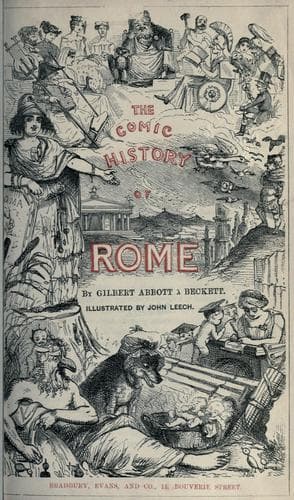
The Comic History of RomeÀ Beckett, Gilbert Abbott
History
The Comic History of Rome
À Beckett, Gilbert Abbott
Rome -- History -- Humor; Wit and humor, Pictorial
The Senate--a term derived from the Latin word _Senes_, old men--formed
the chief council of the state, and its first institution is usually
referred to the reign of Romulus. Three members were nominated by each
tribe, and three by each of the thirty _curiæ_, making ninety-nine in
all, to which Romulus himself is said to have added one, for the purpose
of making up round numbers, and at the same time nominating a sort of
president over the assembly, who also had to take care of the city, in
the absence of the sovereign. There is a difference of opinion as to
whether one hundred new members were added to the Senate at the time of
the union with the Sabines, for Dionysius says there were; but Livy says
there were not; and we are disposed to attach credit to the former, for
he was an extremely particular man, while Livy was frequently oblivious
of caution in giving credence and currency to mere tradition.
Before closing this portion of the narrative of the History of Rome, it
is necessary to warn the reader against believing too much of it. The
current legends are, indeed, _Legenda_, or things to be read, because
every body is in the habit of repeating them; but the student must guard
himself against placing credence in the old remark, that "what everybody
says must be true," for here is a direct instance of what everybody says
being decidedly otherwise. The life and reign of Romulus, are to be
taken not simply _cum grano salis_--with a grain of salt--but with an
entire cellar of that condiment, which is so useful in correcting the
evil consequences of swallowing too much of anything.
FOOTNOTES:
[1] The Lares of the Romans are supposed to have been the Manes or
shades of their ancestors, and consisted of little waxen figures--such
as we should put under shades made of glass--which adorned the halls of
houses. The Lares were sewn up in stout dog's-skin, durability being
consulted more than elegance. The Penates were a superior order of
deities, who were kept in the innermost parts of the establishment, and
took their name from _penitus_, within, which caused the portion of the
house they occupied to be afterwards called the _penetralia_.
[2] Troy destroyed, B.C. 1184. Rome founded, B.C. 753.
[3] From this circumstance the fig was considered figurative of the
foundation of the city, and held sacred in Rome for many centuries.
[4] The Pomœrium was not the actual wall, but a boundary line, held very
sacred by the Romans. It consisted of nothing but the clod turned
inwards by the furrow, and, it is probable, that the offensive act of
Remus was not his leaping over the wall, but his hopping over the clod,
which would, naturally, excite indignation against him as an unmannerly
clod-hopper.
[5] The word Feretrius will strike the merest tyro as being derived from
_fero_, to strike, and meaning to designate Jupiter in his character of
Striker, or Smiter.
Public-domain text, read in full here on John Shaqi.
Reviews
Reviews
No reviews yet
Be the first to share your thoughts on this work.
Join the Discussion
Join the discussion
Sign in to leave a comment or review.
Sign InorCreate an account