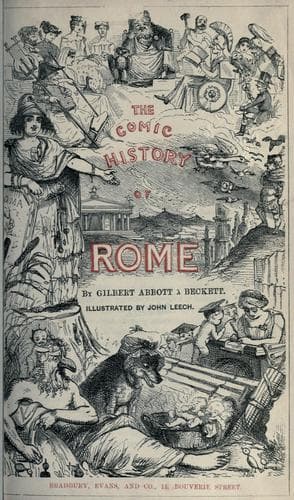
The Comic History of RomeÀ Beckett, Gilbert Abbott
History
The Comic History of Rome
À Beckett, Gilbert Abbott
Rome -- History -- Humor; Wit and humor, Pictorial
Before we have quite done with Romulus, it will be proper to state
how he is said to have divided the people under his sovereignty. He
is alleged to have separated them into three tribes--the Latin word
_tribus_ will here suggest itself to the acute student--namely the Ramnes,
called after the Romans; the Tities, after Titus Tatius; and the Luceres,
who derived their appellation either from one Lucumo, an Etruscan
ally of Romulus, or Lucerus a king of Ardea; or _lucus_ a grove, because
there was no grove, and hence we get _lucerus a non luco_, on the same
principle as _lucus a non lucendo_: or lastly, according to Niebuhr's
opinion, from a place called Lucer or Lucerum, which the Luceres
might have inhabited.
Each tribe was divided into ten _curiæ_,[6] every one of which had a
chapel for the performance of sacred rites, and was presided over by a
_curio_; and the reader must have little curiosity, indeed, if he does
not ask whether our modern word curate may not be referred to this
remote origin. The _curiæ_ were subdivided into gentes, or clans, and
each gens consisted of several families, called gentiles; so that a man
of family and a member of the gentes, became somewhat synonymous. In
time, however, the gentiles got very much mixed by unsuitable marriages;
and hence there arose among those who could claim to belong to a gens, a
distinction similar to that between the _gentes_, or _gents_, of our own
day, and the _gentiles_, or _gentlemen_. Romulus is said to have
selected his body-guard from the three tribes, taking one hundred from
each, and as Celer, the Etruscan, was their captain, the guards got the
name of Celeres--the fast men of the period.
In addition to the tribes, there existed in those early times a separate
body, consisting of slaves, and a somewhat higher class, called by the
name of clients.[7] The latter belonged to the common people, each of
whom was permitted to choose from among the patricians a _patronus_, or
patron, who could claim the life and fortune of his client in exchange
for the cheaper commodities of protection and patronage. The patron gave
his countenance and advice when asked, the client giving his labour and
his money when wanted--an arrangement which proves that clients, from
the remotest times to the present hour, were liable to pecuniary mulcts,
even to the extent of the entire sacrifice of the whole of their
subsistence, for the benefit of those who had the privilege of advising
them.
Public-domain text, read in full here on John Shaqi.
Reviews
Reviews
No reviews yet
Be the first to share your thoughts on this work.
Join the Discussion
Join the discussion
Sign in to leave a comment or review.
Sign InorCreate an account