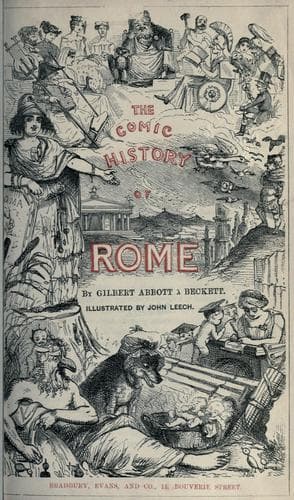
The Comic History of RomeÀ Beckett, Gilbert Abbott
History
The Comic History of Rome
À Beckett, Gilbert Abbott
Rome -- History -- Humor; Wit and humor, Pictorial
Hannibal was now beginning to feel the effects of the policy of delay,
for he was getting out of heart, and was terribly out of pocket. The
harvest had been all gathered in before he could lay his hands upon it;
and he felt it would be idle to take the field, unless he could take the
corn that had grown in it. His army was clamorous for food; and
complaint is never so open-mouthed as when hunger is at the bottom of
it. The Romans began to think the time had arrived for a decisive blow,
and had chosen as one of the Consuls of the year an individual named C.
T. Varro, whom Livy has described as an eloquent meat salesman.[51] He
had been in the habit of going from door to door in the service of his
father, collecting orders for meat in the morning, and taking it round
in the afternoon; but he was determined that his voice should be heard
in something more impressive than a cry of "butcher," at the door-ways
of the citizens. His first flights of eloquence were in the
market-place, where he interlarded his ordinary exclamations of "Buy,
buy," with sarcastic inquiries how long the people would consent to be
sold by those who professed to be their friends and rulers. By degrees,
he quitted the shambles for the platform, and he began attending public
meetings as a professional demagogue. Like those who pursue patriotism
as a trade, he accepted the first offer of a place that was made to him;
and he became in succession a quæstor, an ædile, and a prætor. At length
he was elevated to the consulship, or rather the consulship was lowered
to him; for though the name of Varro became afterwards truly
illustrious, we cannot allow to C. T. the title of respectable. His
colleague, as Consul, was L. Æmilius Paulus, a patrician, who is said to
have cherished a profound hatred of the people; but why he is said to
have done anything of the sort--except it is in slavish subjection to
the old prejudice, according to which all the patricians are supposed to
hate all the people--we are at a loss to discover. The two Consuls were
at daggers drawn between themselves, which prevented them from agreeing
as to the proper time for drawing the sword against the enemy. C. T.
Varro, the ex-butcher, was for cutting and slashing at the Carthaginians
off-hand; but Æmilius Paulus, having consulted a poulterer, declared the
sacred chickens to have lost their appetites, which some considered a
foul pretext, and others a fair excuse, for avoiding a battle. The
Consuls had, however, set out with 80,000 foot, and 6000 horse, which
were encamped on the river Aufidus; their stores being packed up in
baskets and cans at the little town of Cannæ. Hannibal, who was
completely out of elephants--there being not even one left for the
saddle for his own especial use--was compelled to ride the high
horse--the highest he could find among his cavalry--as a substitute. He
took Cannæ under the very eyes and Roman noses of the consuls, one of
Public-domain text, read in full here on John Shaqi.
Reviews
Reviews
No reviews yet
Be the first to share your thoughts on this work.
Elsewhere in the archive
Join the Discussion
Join the discussion
Sign in to leave a comment or review.
Sign InorCreate an account