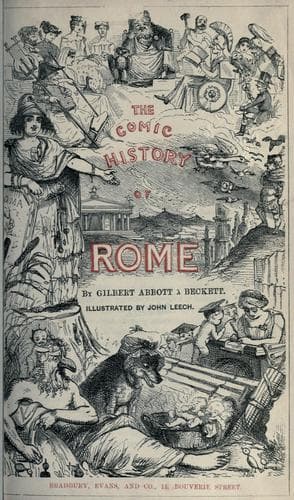
The Comic History of RomeÀ Beckett, Gilbert Abbott
History
The Comic History of Rome
À Beckett, Gilbert Abbott
Rome -- History -- Humor; Wit and humor, Pictorial
whom, Varro, would have fought, but Æmilius Paulus, the other, had taken
the sacred chickens so much to heart, that he had not courage for
anything.
[Illustration: Young Varro.]
At length, on the 2nd of August, Hannibal, whose pockets were empty of
cash, and whose baggage was bare of provisions, determined to provoke
the Romans to a battle. Had the policy of Fabius Cunctator, "slow
coach," been pursued at this stage, the defeat of the Carthaginians was
certain, for they were an army of mercenaries without pay, and in ten
days there would not have been a bone for the dogs of war to feed upon.
Hannibal, who had always much tact in discovering which way the wind
blew, was taking a walk in the morning, when his eyes getting suddenly
filled with dust, caused him to see a point that had hitherto escaped
him. It occurred to him at once that, by placing his army with its back
to the wind, the Romans who faced him would have to face a blow which
might prove very embarrassing. He knew that the dust would set the
Romans rubbing their eyes, or even if they did not raise a hand against
the inconvenience, they would, at all events, be compelled to wink at
it. In order to increase the annoyance, he ordered the ground to be
thoroughly well ploughed, and though he had not the advantage of shot,
he found the dust a very good substitute for powder. He had placed the
Gauls in the middle, supported by Africans on each side, and the Romans
having first attacked the centre, which gave way, were enclosed between
the two wings; a position in which they were so hard pressed, that they
could not get out of the claws of the enemy.
The slaughter was, as usual, tremendous, 45,000 being left dead on the
field, or rather, in conformity with the excess of caution used in those
days to prevent the return of an adversary to life, being "cut to
pieces." Æmilius Paulus, the patrician, who had been reluctant to fight,
was killed while boldly combating with his sword in his hand, but Varro,
the patriotic butcher, who had been all ardour and enthusiasm to strike
the decisive blow, ran off as fast as his horse's heels could carry him.
He reached Rome in safety, and such a perfect master was he of the
demagogue's art, that he succeeded in obtaining the thanks of the Senate
for his services. It was true that he had shown boldness, amounting to
rashness, when the security of the army was at stake, and he had
exhibited caution amounting to cowardice, in taking care of himself, by
running away when the battle was lost; but he had got the character of
the "people's friend," and the people are often a long time in finding
out, and casting off, those who are in the habit of duping them.
Public-domain text, read in full here on John Shaqi.
Reviews
Reviews
No reviews yet
Be the first to share your thoughts on this work.
Elsewhere in the archive
Join the Discussion
Join the discussion
Sign in to leave a comment or review.
Sign InorCreate an account