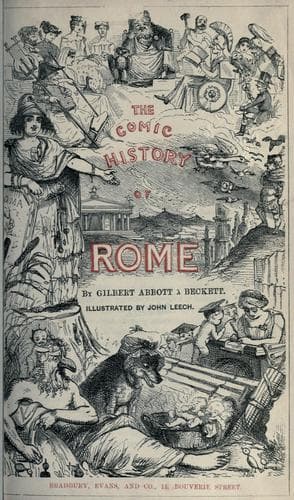
The Comic History of RomeÀ Beckett, Gilbert Abbott
History
The Comic History of Rome
À Beckett, Gilbert Abbott
Rome -- History -- Humor; Wit and humor, Pictorial
Numa Pompilius was, according to all accounts, a just ruler, and he
began his career in a ruler-like manner by drawing several straight
lines about Rome, to mark its boundaries. He placed these under a deity,
termed Terminus, and he erected twelve stones within a stone's throw of
each other, at regular intervals along the frontier. These were visited
once a year by twelve officers, called Fratres Arvales, appointed for
the purpose, and the custom originated, no doubt, the parochial practice
of perambulating parishes with wands and staves, placed in the hands of
beadles, who not unfrequently add the luxury of beating the boys to the
ceremony of beating the boundaries.
[Illustration: Numa Pompilius remembering the Grotto.]
Numa, though he had come to the throne, was fond of the retired walks of
life, and frequently took a solitary stroll in the suburbs. During one
of his rambles chance brought him to a grotto, and he was induced to
remember the grotto by the surpassing loveliness of its fair inhabitant.
Her name was Egeria, her profession that of a fortune-teller, which gave
her such an influence over the superstitious mind of Numa, that she
ruled him with her divining rod as completely as if it had been a rod of
iron. He professed to act under the advice of this nymph, to whom
tradition--an inveterate match-maker--has married him, and he instituted
the Flamines, an order of priests, to give weight to the falsehoods or
"flams" he thought fit to promulgate. The privileges of the Flamines
were not altogether of the most comfortable kind, and consisted chiefly
in the right of wearing the Apex--a cap made of olive wood--and the
Laena, a sort of Roman wrap-rascal, shaggy on both sides, and worn above
the toga, as an overcoat. The Flamen was prohibited from appearing in
public without his Apex, which could not be kept on the head without
strings; but such was the stringency of the regulations, that one
Sulpicius[8] was deprived of his priesthood, in consequence of his
official hat, which was as light as a modern zephyr, having been blown
off his head in the midst of a sacrifice.
Numa added, also, a sort of _ballet_ company to the mythological
arrangements of his day, by establishing twelve _Salii_, or dancing
priests, whose duty it was to execute a grand _pas de douze_ on certain
occasions through the principal public thorough fares. The Salii, though
a highly respectable, were not a very venerable order, for no one could
remain in it whose father and mother were not both alive, the existence
of the parents of the dancing priests being, no doubt, required as a
guarantee that their dancing days were not yet over.
Public-domain text, read in full here on John Shaqi.
Reviews
Reviews
No reviews yet
Be the first to share your thoughts on this work.
Join the Discussion
Join the discussion
Sign in to leave a comment or review.
Sign InorCreate an account