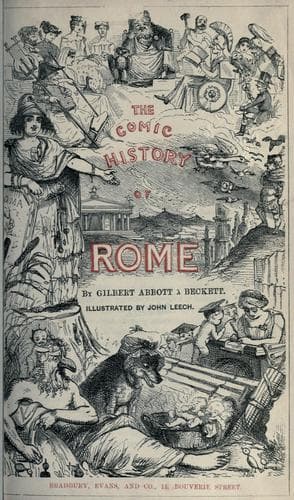
The Comic History of RomeÀ Beckett, Gilbert Abbott
History
The Comic History of Rome
À Beckett, Gilbert Abbott
Rome -- History -- Humor; Wit and humor, Pictorial
Several temples are dated from this reign, including that of Janus, the
double-faced deity, who presided over peace and war--a most appropriate
office to one capable of looking two ways at once, for there are always
two sides to every quarrel. This temple must have been perfectly useless
during the life of its founder, for it was never to be opened in the
time of peace, and Numa preserved for Rome forty-three years of
undisturbed tranquillity. He was emphatically the friend of order, and
its usual consequences, prosperity to trade, with soundness of credit,
and he encouraged commerce by giving a patron-saint or Lar to every
industrial occupation. He marked also the value of good faith by
building a temple to Bona Fides, and it may be presumed that the
creditor, who, putting up with the loss of his little bill, sacrificed a
bad debt in this Temple, was still in hope that he should eventually
find his account in it.
If it cannot be said that Numa never lost a day, it must be admitted
that he made the most of his time; for he added two whole months to the
year of Romulus. January and February were the names given to the time
thus gained; but as the year did not then correspond with the course of
the sun, it was usual to introduce, every other year, a supplementary
month, so that if one year was too short, the next, by being too long,
made it as broad as it was long in the aggregate.
Numa Pompilius lived to be eighty-two; when he had the beatitude of
dying as peacefully as he had lived; and so gently had Nature dealt with
him, that she had suffered him to run up more than four scores, before
her debt was satisfied. Certain stories are told of the funeral
ceremonies that followed Numa's death; and it is said that the Senators
acted as porters to his bier, in token of their appreciation of the
imperial measures which Numa had himself carried. It has been stated,
also, that he caused to be placed, within his tomb, a copy, on papyrus,
or palm leaves,[9] of his own works, in twenty-four books; and it is
certainly a happy idea to bury an author with his writings, when, if
they have been provocative of sleep in others, he may eventually reap
the benefit of their somniferous properties.
Public-domain text, read in full here on John Shaqi.
Reviews
Reviews
No reviews yet
Be the first to share your thoughts on this work.
Join the Discussion
Join the discussion
Sign in to leave a comment or review.
Sign InorCreate an account