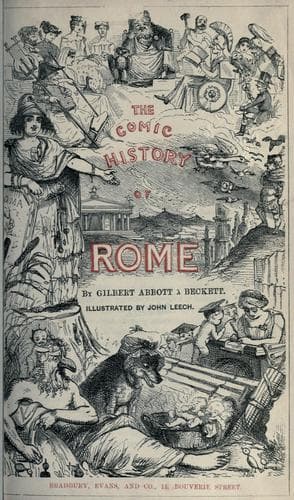
The Comic History of RomeÀ Beckett, Gilbert Abbott
History
The Comic History of Rome
À Beckett, Gilbert Abbott
Rome -- History -- Humor; Wit and humor, Pictorial
It is stated that one Vibius Virrius, the chief of the Senate, on the
eve of the opening of the gates, gave a sort of legislative supper to
twenty-eight of the members, and, at the conclusion of a hearty meal, he
produced a cup, with the contents of which he proposed that every one
present should poison the remainder of his own existence. The deadly
potion was poured out into twenty-nine different vessels, and, with
faces more or less wry, the Senators swallowed the fatal mixture. On the
surrender of the place, the citizens were sold for slaves; and it must
be admitted that they had shown themselves fit for little better than
the fate assigned to them.
In the year previous to the fall of Capua, Hannibal had taken Tarentum;
but, three years later, the stupidity or treachery of the general in
charge, or man in possession, had allowed Q. Fabius Maximus to take it
back again. Hannibal was thus daily losing territory, and his cause was
consequently losing ground. Many small states which had adhered to him
because they believed him to be strong enough to assist them, withdrew
from him directly he appeared as if he could not help himself.
Hasdrubal, the brother of Hannibal, had been harassed in Spain by the
two Scipios--Cn. C. and P.--when fortune cleared the stage for him, by
killing both within a month, and annihilating both their armies. The
fate of the two leaders had such an effect in Rome, that when those
eligible to command had heard the particulars, they had no inclination
to act as generals. Every one seemed to fear that if he went to head the
army in Spain, he should be simply going to his own funeral, and every
one naturally shrunk from such an undertaking. At length young P. C. S.
A. M.--or, to give his name at full length, Publius Cornelius Scipio
Africanus Major--who was only twenty-four years of age, though he had
entered the army at seventeen, and had been present, or rather absent,
at the battle of Cannæ, where the only survivors were those who ran
away--volunteered to supply the places of his deceased relatives. An
objection was, at first, made to his age--or rather to his want of
age--but, as there was no older candidate for the post of honour and of
danger, he was permitted to step into it. His popularity was, in some
measure, owing to his having acquired the character of a serious young
man; for ever since he had assumed the toga virilis--an assumption
something like the modern practice of going into stick-ups--he had been
in the habit of passing his mornings in the Temple of Jupiter. He
proceeded to Spain, with the title of Pro-consul, and an army of about
11,000 men, at the head of whom he proceeded to Carthagena; where he
knew the enemy kept the greater portion of their cash, their corn, and
their captives. He was accompanied by his friend Lælius, who commanded
the fleet, and who was sent to make an unexpected attack from the sea;
for Scipio, who was very deep, had ascertained that the water was very
shallow.
Public-domain text, read in full here on John Shaqi.
Reviews
Reviews
No reviews yet
Be the first to share your thoughts on this work.
Elsewhere in the archive
Join the Discussion
Join the discussion
Sign in to leave a comment or review.
Sign InorCreate an account