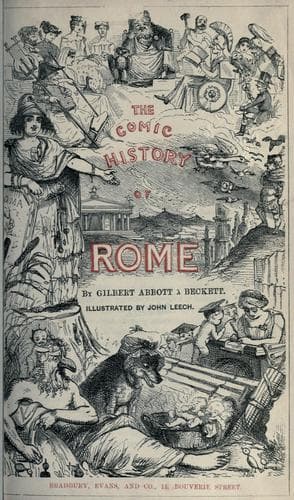
The Comic History of RomeÀ Beckett, Gilbert Abbott
History
The Comic History of Rome
À Beckett, Gilbert Abbott
Rome -- History -- Humor; Wit and humor, Pictorial
The defenders of New Carthage had relied upon the ocean as a
defence; but they had, in reality, built their hopes on sand, which,
during the prevalence of a particular wind and tide, afforded easy
access to the city. The place speedily fell into his hands; and his
gallantry--in a double sense--made him with the brave and the fair an
equal favourite. Towards the ladies he was particularly amiable; and he
not only sent back to her lover an interesting young girl, but he
returned to her husband a maudlin old woman. The latter was the aged
wife of the chief Mardonius, who weepingly implored that her sex might
be treated with respect; when the young soldier, hiding his face in his
sleeve, either cried or laughed in it.
[Illustration: Considerate Conduct of Scipio Africanus.]
Hasdrubal now turned his attention to Italy, while Scipio continued his
conquests in Spain, and, among other places, took Astapa, which, if
tradition tells the truth, he must have found without a single
inhabitant. It is said that the place was defended with such valour that
only fifty men remained alive, and these became impressed with the
feeling that when a thing must be done, it is better to do it oneself
than to leave it to be done by others. They came to the resolution that
they were sure not to be spared, and they had, therefore, better get rid
of one another. They accordingly proceeded to the sanguinary task of
mutual destruction; though, as one must have remained to the last, and
there would have been some difficulty in disposing of him, it is
probable that he survived for the purpose of acting as his own reporter
of the dreadful incident. The graver historians insist that not one was
left alive in the city; that the last fifty soldiers, having first
killed all their women, and all their children, made away with all of
themselves; a state of things which induces us to ask how the
particulars have come down to us. If, however, we were to indulge this
spirit of inquiry to any extent, we should, we fear, be compelled to
throw a doubt upon many of those interesting particulars which form the
most agreeable portions of history.
Public-domain text, read in full here on John Shaqi.
Reviews
Reviews
No reviews yet
Be the first to share your thoughts on this work.
Elsewhere in the archive
Join the Discussion
Join the discussion
Sign in to leave a comment or review.
Sign InorCreate an account