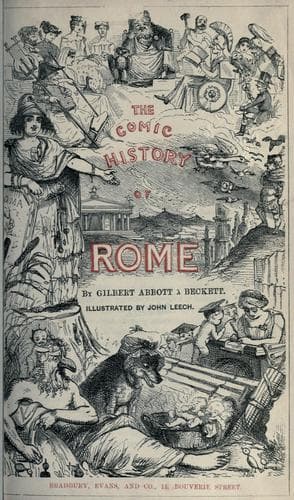
The Comic History of RomeÀ Beckett, Gilbert Abbott
History
The Comic History of Rome
À Beckett, Gilbert Abbott
Rome -- History -- Humor; Wit and humor, Pictorial
Hasdrubal resolved to make a grand effort, and assembled an army, which
including some Iberians, under his brother Mago, as well as some
Numidians, headed by Masinissa, their king, numbered 75,000 men, and
six-and-thirty elephants. Scipio, though objecting to attack a power
more than twice his size, was compelled to do so, by a want of
provisions, for he had so little food that his army could not even have
grubbed on for a month or two. He was again victorious, and Hasdrubal
proceeded to join his brother Hannibal; but the letters written by the
former to apprise the latter of his coming, instead of going regularly
through all the military posts, fell, by some misdirection or
indirection, into the hands of the enemy. The Consul Livius Salinator
went into the neighbourhood of Sena Gallica--now Senigaglia--and was
joined by his colleague, C. Claudius Nero, who came, under cover of the
night, with a large army; and it would appear that the forces of
Hasdrubal kept such very early hours, that they had all gone to bed, and
knew nothing of the reinforcements that had been sent against them.
Hasdrubal, however, saw among the Romans, on the following morning, some
soldiers, whose faces were so sun-burnt, as to give a strange complexion
to a part of the troops, and he concluded that they had recently been on
a journey. After having indulged in an inquiring look, he commenced a
patient listen, and he fancied he heard two trumpet calls in the hostile
camp, when, without considering whether the second might have been the
mere echo of the first, he resolved, in his own mind, that the armies
of the two Consuls had joined together. He accordingly determined to
fly, and began by trying to swim across the river Metaurus, which is
usually shallow enough; but the rains had swelled it to such a torrent
that he was soon plunged into the depths of misery. His guides,
following the impulse of their own cowardice, ran away as fast as they
could, and he, in perfect ignorance of the country, found the river
rising and his spirits sinking in about an equal ratio. The Romans came
up with him in time to find his army completely damped, and his troops
were, according to the military practice of the period, cut, at once, to
pieces.
Hasdrubal, who had lost heart early in the battle, seems ultimately to
have lost his head, for rushing into the midst of a cohort, he was
decapitated by a Roman soldier. It is said that the head of Hasdrubal
was afterwards brutally thrown into the camp of his brother Hannibal;
but happily for the credit of humanity, this story of the head is absurd
on the very face of it.
Public-domain text, read in full here on John Shaqi.
Reviews
Reviews
No reviews yet
Be the first to share your thoughts on this work.
Elsewhere in the archive
Join the Discussion
Join the discussion
Sign in to leave a comment or review.
Sign InorCreate an account