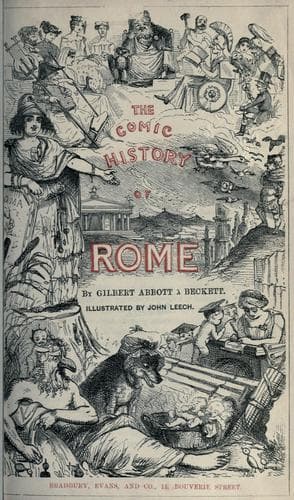
The Comic History of RomeÀ Beckett, Gilbert Abbott
History
The Comic History of Rome
À Beckett, Gilbert Abbott
Rome -- History -- Humor; Wit and humor, Pictorial
Spain was now subject to Rome; and Scipio, after quelling an
insurrection in his army, paid a visit to Syphax, who was king of a
portion of Numidia, and who was desperately in love with a young lady,
named Sophonisba, the daughter of Hasdrubal Gisco, a Carthaginian
general. Sophonisba was one of those troublesome persons, known as
fascinating creatures, who, by attracting the eyes of mankind, set them
very often by the ears, and lead to much calamity. This too interesting
individual had also won the admiration of Masinissa, another king of
another part of Numidia, when her father, irrespective of any attachment
she might have formed, gave her hand to Syphax, by way of attaching the
latter to his interests. Masinissa, in a fit of jealousy, went over to
Rome, leaving Syphax and Hasdrubal to fight it out with Scipio.
The Africans and Carthaginians were, to a certain extent, people of
straw, which was the material they used in constructing their tents, and
Scipio, basely pretending that he desired to negotiate a peace, sent a
set of firebrands, under the garb of envoys, into the camp of the enemy.
These hypocritical incendiaries carried fire among the foe; and, though
the elephants fought like lions, the Carthaginians behaved like lambs,
for the poor creatures, thinking the burning of their tents was
accidental, looked on with simple bewilderment. 40,000 Africans were cut
to pieces on the spot; and Syphax, who had managed to escape, was ready
immediately with 30,000 more, to engage Scipio in the neighbourhood of
Utica. Syphax was urged on by his wife, who is described as a woman of
remarkable spirit--a character equivalent to that of a very troublesome
body. Poor Syphax did all he could against a very superior force, but he
was ultimately taken prisoner, and sent to Scipio, while Sophonisba
remained at home to receive Masinissa--like a woman of spirit--at the
gates of her husband's palace.
The lovely creature, admitting that she was vanquished, and declaring
that further opposition would be vain, appealed, in the character of an
unprotected female, to the generosity of Masinissa. Expressing the
utmost horror at being placed as a captive behind the car of Scipio, she
entreated the protection of her husband's conqueror; and Masinissa, not
knowing exactly what to do, politely offered to marry her. She at once
consented; and, after a widowhood of a few hours, she was presented to
Lælius, the Roman Consul, in her new character.
Syphax, not being dead, was of course rather painfully alive to the
conduct of his wife, and having hinted to Scipio that she might be the
cause of further mischief, an order was immediately sent to Masinissa to
send her back by the bearer. This her new husband was unwilling to do,
but he forwarded her a cup of poison, which she drank off with the air
of a tragedy queen, and died with a clap-trap in her mouth, which was
almost as nauseous as the stuff that she was called upon to swallow.
Public-domain text, read in full here on John Shaqi.
Reviews
Reviews
No reviews yet
Be the first to share your thoughts on this work.
Elsewhere in the archive
Join the Discussion
Join the discussion
Sign in to leave a comment or review.
Sign InorCreate an account