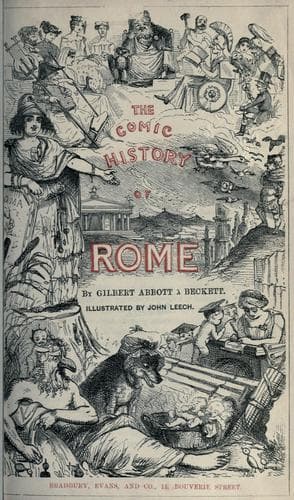
The Comic History of RomeÀ Beckett, Gilbert Abbott
History
The Comic History of Rome
À Beckett, Gilbert Abbott
Rome -- History -- Humor; Wit and humor, Pictorial
The Carthaginians now began to feel that every thing went wrong in the
absence of Hannibal, whom they invited home, and on his arrival he was
really anxious for peace and quietness. Scipio felt much the same, and
the two generals, having met, looked at each other for some time in
silent admiration. It may be doubted whether they got any further than
this point, for even if they had a few words, it did not prevent them
from ultimately coming to blows at the great and decisive battle of
Zama. Hannibal brought into the field 50,000 men, and about 80 real
elephants; but his soldiers were most of them raw, and liable to be
roasted on the ground of extreme awkwardness. He put the Moors, the
Gauls, and Libyans in front, the Carthaginian cowards in the centre, for
they were but a middling set, and he brought up the rear, with a few of
his best soldiers. Scipio exhibited some very skillful generalship on
this momentous occasion, and by a clever arrangement of his forces, he
left room for the elephants to run through the ranks without coming into
contact with any of his soldiers.
The success of Scipio was complete; and Hannibal returned to Carthage
after an absence of thirty-six years; having so far forgotten the
manners and customs of his country, that, during a debate in the Senate,
he dragged a noble--whose sentiments did not exactly coincide with his
own--by force from the tribune. On being called to order, he explained
that he had forgotten the forms of the house; and the discussion
proceeded as if nothing particular had happened. Carthage made peace
with Rome, on very advantageous terms to the latter; and Scipio, who
took the name of Africanus, enjoyed the honours of a triumph, at which
poor Syphax--who appears to have been everybody's victim--was obliged to
figure in fetters.
The terms imposed upon Carthage were very severe; for she was to deliver
up, without ransom, all the Roman prisoners: to surrender nearly all her
ships; and to part with all her elephants. She was also to pay over a
considerable sum in cash,--a stipulation which set the Senate off into a
roar of anguish, and caused Hannibal sneeringly to exclaim that "the
only thing to draw tears from their eyes was to draw money from their
pockets."[54]
Public-domain text, read in full here on John Shaqi.
Reviews
Reviews
No reviews yet
Be the first to share your thoughts on this work.
Elsewhere in the archive
Join the Discussion
Join the discussion
Sign in to leave a comment or review.
Sign InorCreate an account