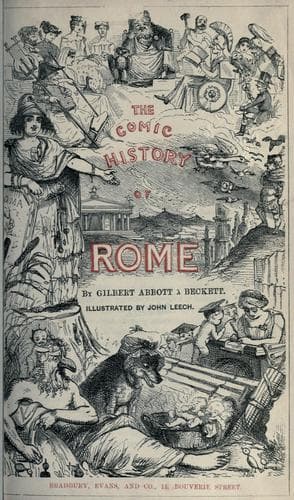
The Comic History of RomeÀ Beckett, Gilbert Abbott
History
The Comic History of Rome
À Beckett, Gilbert Abbott
Rome -- History -- Humor; Wit and humor, Pictorial
Though Rome had been victorious, so fatal is war to all who engage in
it, that her successes had brought her almost to the verge of ruin.
Scenes of cruelty had dyed the country with blood, and left a stain upon
it which could not easily be effaced; and wherever the sword of war had
been brandished, nothing else had flourished. Troops had been raised
merely to be cut down; the country had been wasted on all sides; and
there had been a still more terrible waste of human existence. While
life was being made so cheap, the means of supporting it were getting
dearer every day; for provisions rose to an enormous price under the
influence of a system which converted the ploughshare into the sword,
and turned what should have been fields of corn into fields of battle.
To meet the expenses of the war, the public had been obliged to run into
debt; and there is no process to which the term running is more properly
applied, though the opposite movement is always slow, and often
impossible.
The Carthaginian fleet having been destroyed, Rome became nominally
mistress of the seas; but, for want of means, she made a very bad
mistress, and the sea might be said to maintain a mastery over her.
War, however, had been in some degree productive of good; for it had led
to the recognition of the great principle that the public service was
not to be monopolised by the privileged few, inasmuch as where there is
real work to be done, there is scope for the talents and energies to be
met with among the many. Wealth, however, had become a passport to
public employment; and the door could be opened by a golden key, which
has, in modern times, served most appropriately as the emblem of office.
The drain upon the resources of the nation was so considerable, in
consequence of the frequent wars, that the Senators sent their plate to
the treasury, and received bank bills instead,--an arrangement as
satisfactory as exchanging silver dishes for silver paper. The merchants
supplied dresses for the troops on the same terms, and accepted printed
rags for comfortable clothing.
Superstition also sensibly--or rather foolishly--increased during the
wars against Carthage; and the Sibylline books were consulted from time
to time, though usually with no other result than the recommendation of
a job, to be performed by Government Commissioners. On one occasion the
books were declared to require that Cybele should be brought to Rome;
and ambassadors were appointed, at a considerable expense, to go to
Phrygia, for the purpose of fetching her. They professed to find her,
and bring her home; but upon their arrival, they produced nothing but a
large black stone, which the people welcomed as a most precious stone,
and which they were contented to receive as the goddess they required.
FOOTNOTES:
[52] The term εὕρηκα has lately been applied to a newly-invented shirt;
but the term is extremely inappropriate, for the philosopher had no
shirt on when he proclaimed his great discovery.
Public-domain text, read in full here on John Shaqi.
Reviews
Reviews
No reviews yet
Be the first to share your thoughts on this work.
Elsewhere in the archive
Join the Discussion
Join the discussion
Sign in to leave a comment or review.
Sign InorCreate an account