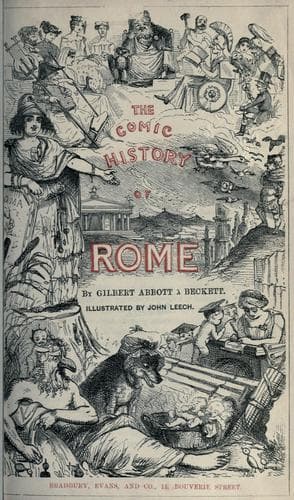
The Comic History of RomeÀ Beckett, Gilbert Abbott
History
The Comic History of Rome
À Beckett, Gilbert Abbott
Rome -- History -- Humor; Wit and humor, Pictorial
For some time they lived in peace, though their homes were knocked to
pieces; but a war broke out again, in the year of the City 572 (B.C.
181). The Spaniards, however, were not thoroughly reduced until four
years after, though they were being continually killed, beaten, cut to
pieces, and otherwise dealt with, in a manner from which their reduction
would seem to flow as a natural consequence. It was Tib. Sempronius
Gracchus--the father of the two great Gracchi, of whom we shall have
something to say hereafter--that concluded peace with several of the
Spanish tribes, who were brought down so low, that their being otherwise
than peaceable was almost impossible.
The Romans continued to intrude themselves and their system on
different parts of Europe, and planted a colony at Aquileia, in Istria,
which caused the Istrians to try and put a full stop to the disposition
which Rome had shown to colon-ise. A war ensued, which resulted in the
loss of three towns and one king, when the Istrians came to the
conclusion that they had had enough of it, and immediately submitted to
the Roman authority.
[Illustration: Hannibal requesting the Cretan Priests to become his
Bankers.]
Having, for a time, lost sight of the illustrious Hannibal, we begin to
look about for him once more, and find him living in a Court, kept by
one Prusias, the greedy and needy king of Bithynia. After the treaty
made by Antiochus and the Romans, Hannibal had fled to Crete, where he
could not long remain; and, though history is silent as to the cause, we
may conjecture something from the fact, that he effected a clandestine
removal of all his wealth, though he pretended to leave behind him a
vast amount of treasure. Tradition states that, having procured a number
of earthen jars, he filled them with lead, and, strewing a little gold,
or loose silver, over the top, he carried them to the temple of Diana,
and requested the Cretan priests to become his bankers, for the purpose
of his entrusting to them this valuable deposit. The priests assured
him, with many protestations, that he would find it all right on his
return; and Hannibal, having previously packed all his real gold into
the hollow insides of some statues of brass, which he pretended to carry
with him, in his character of an admirer of the arts, got clear off with
all his money.
Public-domain text, read in full here on John Shaqi.
Reviews
Reviews
No reviews yet
Be the first to share your thoughts on this work.
Elsewhere in the archive
Join the Discussion
Join the discussion
Sign in to leave a comment or review.
Sign InorCreate an account